
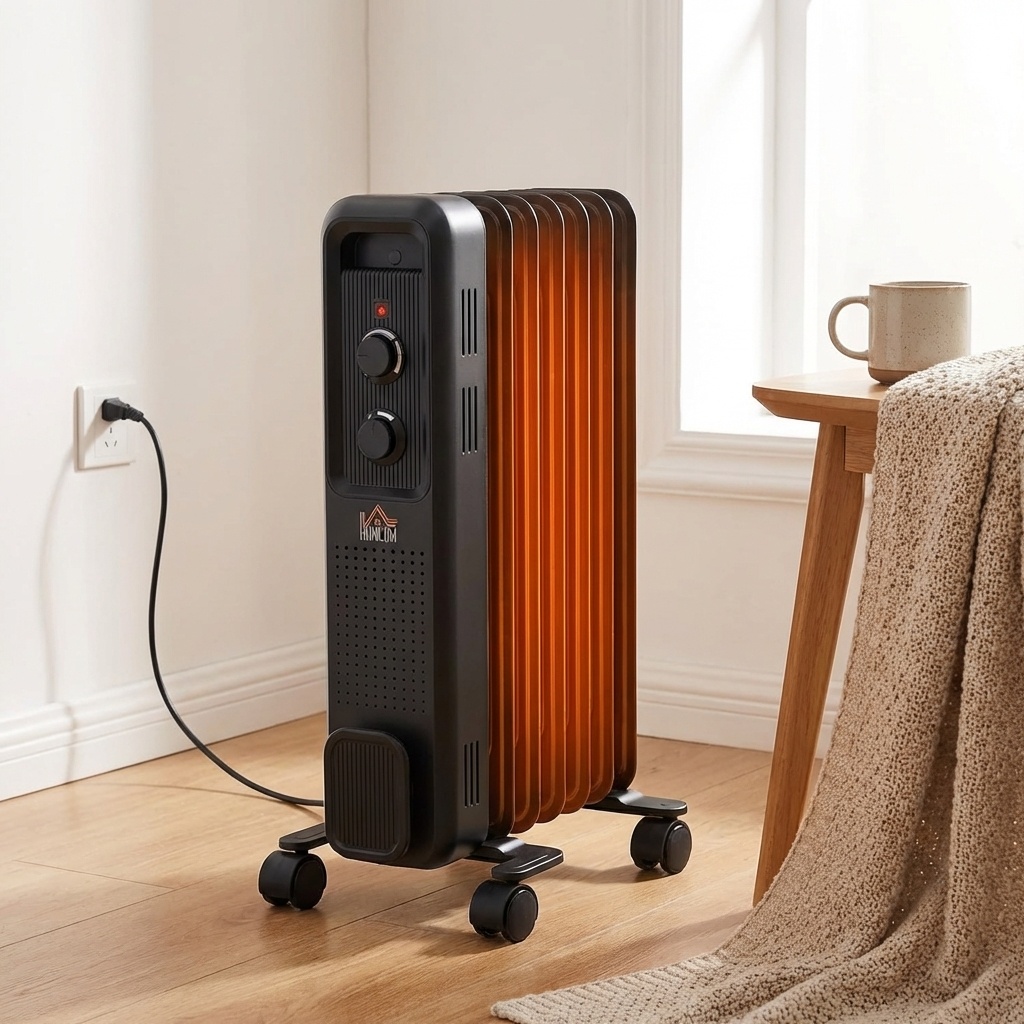
A HOMCOM heater like an oil-filled radiator tends to suit people who want steady, low-fuss warmth rather than a fast blast of heat. That framing matters, because expectations are where most disappointment starts.
This review focuses on the HOMCOM 1500W Oil Filled Radiator as a practical, room-by-room electric heating option—useful in the right context, but not a universal fix for every cold space or schedule.
Oil-filled radiators occupy an odd middle ground in home comfort. They are portable enough to move around, yet they behave more like a slow, stable heat source than a “quick warm-up” device. The payoff is often a more even feel across time. The trade-off is patience.
With the HOMCOM heater category, buyers often assume “1500W” automatically translates into rapid warmth and whole-room transformation. In practice, wattage sets an upper ceiling; how that warmth feels depends on the room’s heat loss, air movement, and how long the unit is allowed to run before judging it.
Quick Orientation: What This HOMCOM Heater Is (And Is Not)
- It is a portable, oil-filled style HOMCOM electric heater designed for gradual, sustained warmth, typically more comfortable over longer stretches than stop-start heating.
- It is not the most convincing choice for instant heat in a draughty space where doors open frequently and warm air escapes quickly.
- Safe assumptions: it will feel most effective when left to build temperature, with a sensible thermostat setting and a reasonably enclosed room.
- Misleading assumptions: that it behaves like a fan heater, or that “higher setting” always feels better if the room is already losing heat faster than it can be replaced.
Why People Consider a HOMCOM Oil Filled Radiator in the First Place
An oil-filled HOMCOM radiator is usually considered for comfort continuity. The heat is less aggressive, less “windy”, and can feel more natural in a living space where people are seated for long periods. That makes it attractive for evening use, home working, and bedrooms where harsh airflow can be intrusive.
There is also a practical angle: portability. A HOMCOM portable electric heater on wheels can be repositioned without committing to a fixed installation. That flexibility is valuable in homes where only one or two rooms need extra warmth at certain times—though it also means performance is judged room-by-room, not as a whole-home solution.
Cost expectations need to stay grounded. An electric radiator can be a controlled, targeted source of heat, but it is still an electrical load. The sensible decision question is not “is it cheap to run?” but “does it reduce the need to heat more space than necessary?” In small-to-medium rooms with decent insulation, that can be a rational trade.
What to Look at First When Evaluating This HOMCOM Electric Heater
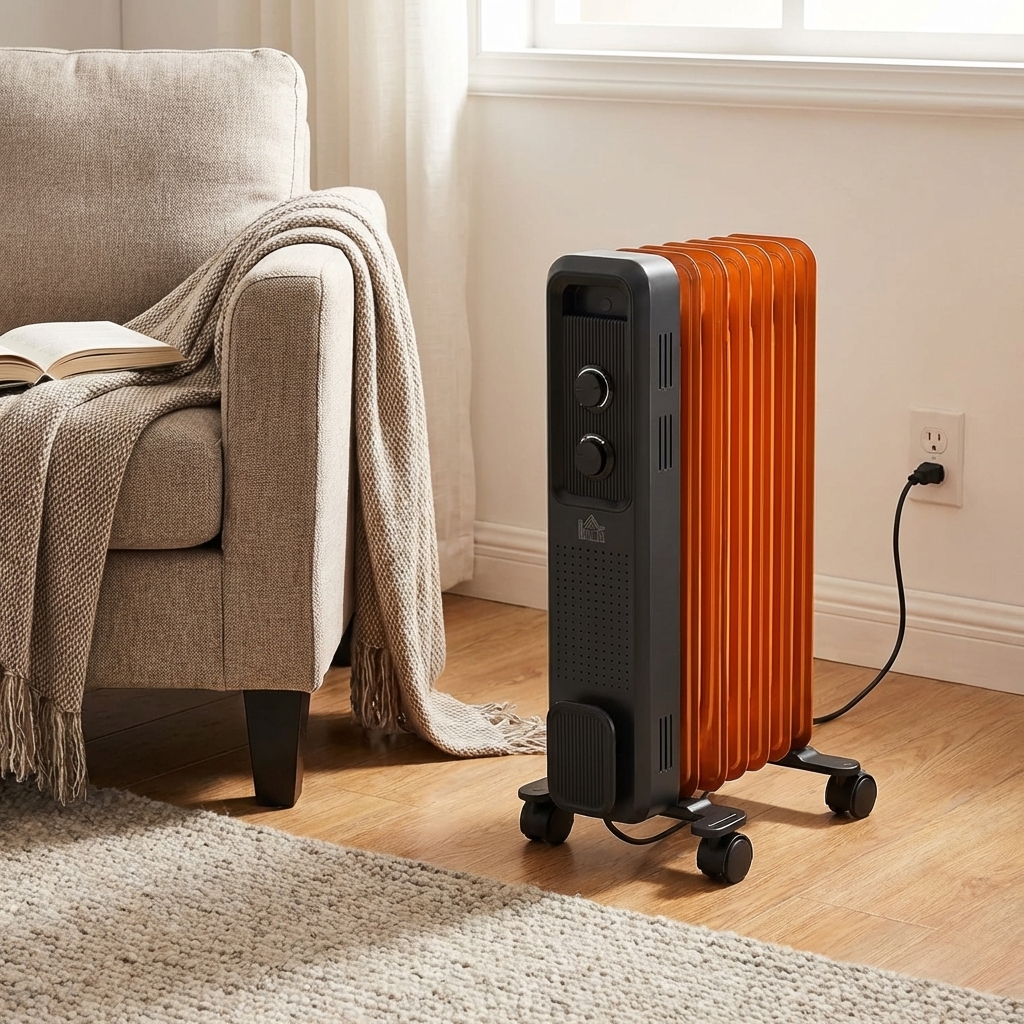
Before getting pulled into feature lists, the more useful evaluation starts with how the unit will actually be lived with. Oil-filled radiators are often purchased in a hurry—cold snap, unexpected bills, a room that never feels quite right—then judged too quickly.
Key decision points that tend to matter more than the headline wattage:
- Heat-up patience: this style rewards steady operation; it can feel underwhelming if it is only switched on for short bursts.
- Room containment: open-plan layouts, frequent door opening, or persistent draughts can make any 1500W heater feel like it is “working hard” without the comfort catching up.
- Placement: oil-filled radiators need breathing room; tucked behind furniture or tight to soft furnishings, warmth distribution suffers and safety margins shrink.
- Noise tolerance: typically quiet overall, but real homes are quiet at night—small clicks as thermostats cycle can matter to light sleepers.
How the HOMCOM 1500W Oil-Filled Style Typically Feels in Real Rooms
The most characteristic thing about an oil-filled HOMCOM heater is the texture of the warmth. It builds slowly and then tends to feel stable—less like “hot air” and more like a room that gradually stops feeling cold. In a reasonably sealed room, that steadiness can translate into comfort that keeps its shape even when the heater cycles on and off.
Where it can feel less satisfying is the “first ten minutes” problem. People who want an immediate sensation of warmth on hands and face may interpret the slow ramp-up as weak performance, even when the room temperature is trending upward. The decision here is simple: if the heater is meant to rescue a cold room quickly, this format is not always the best match.
For buyers browsing HOMCOM heaters, it helps to separate two goals that often get mixed together: quick relief versus sustained comfort. An oil-filled radiator leans hard toward the second goal, and that is the lens this review will keep using.
Where This HOMCOM Radiator Sits Within the Wider HOMCOM Heater Range
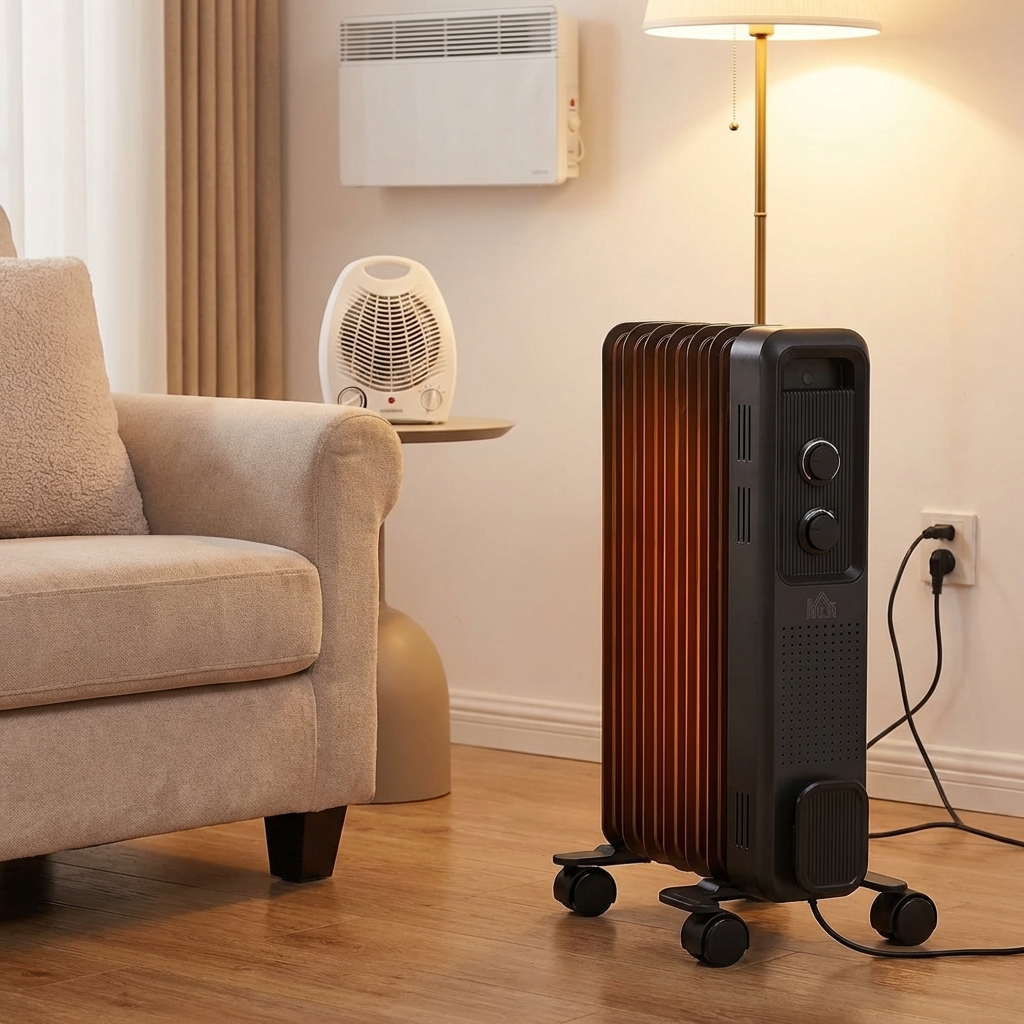
HOMCOM heaters cover multiple heating styles, and that matters because the “right” choice is often about behaviour rather than brand. The oil-filled approach prioritises slower, more even comfort; other styles in the same brand family can prioritise speed, wall placement, or a different balance between airflow and warmth.
This distinction is not academic. It affects whether a HOMCOM electric heater feels “right” day to day—especially in homes where the heater is used intermittently, moved between rooms, or relied on during quiet hours.
Heat Delivery and Comfort: Where a HOMCOM Heater Feels Strongest
With the main HOMCOM heater in this review—an oil-filled radiator format—the core performance story is less about instant intensity and more about how the warmth is experienced over time. Oil-filled designs typically reward steady, longer sessions: the unit’s mass holds heat and smooths out the “on/off” feel that can make some electric heaters seem twitchy in use. In a lived-in room, that often translates into a calmer thermal profile rather than a dramatic blast of hot air.
This is also where expectations need to be set with some precision. A HOMCOM electric heater in this style can feel underwhelming if the goal is rapid spot-warming right after entering a cold space. The warmth builds, and it tends to feel more even once the surrounding surfaces start to lose less heat. In practical terms, it suits rooms that are occupied for a while—home office blocks, evening living-room use, or background heating while doing quiet tasks—more than short, in-and-out use.
- Comfort tends to be better when the unit can run steadily without being forced into short cycles, because the perceived temperature swing is smaller.
- It generally feels more natural in rooms where draughts are limited; strong air movement can strip warmth faster than a radiator-style HOMCOM heater can replenish it.
- For people sensitive to “hot air” sensations, the gentler output profile is usually a better match than fan-led heating.
Controls and Day-to-Day Handling: The Practical Side of a HOMCOM Heater
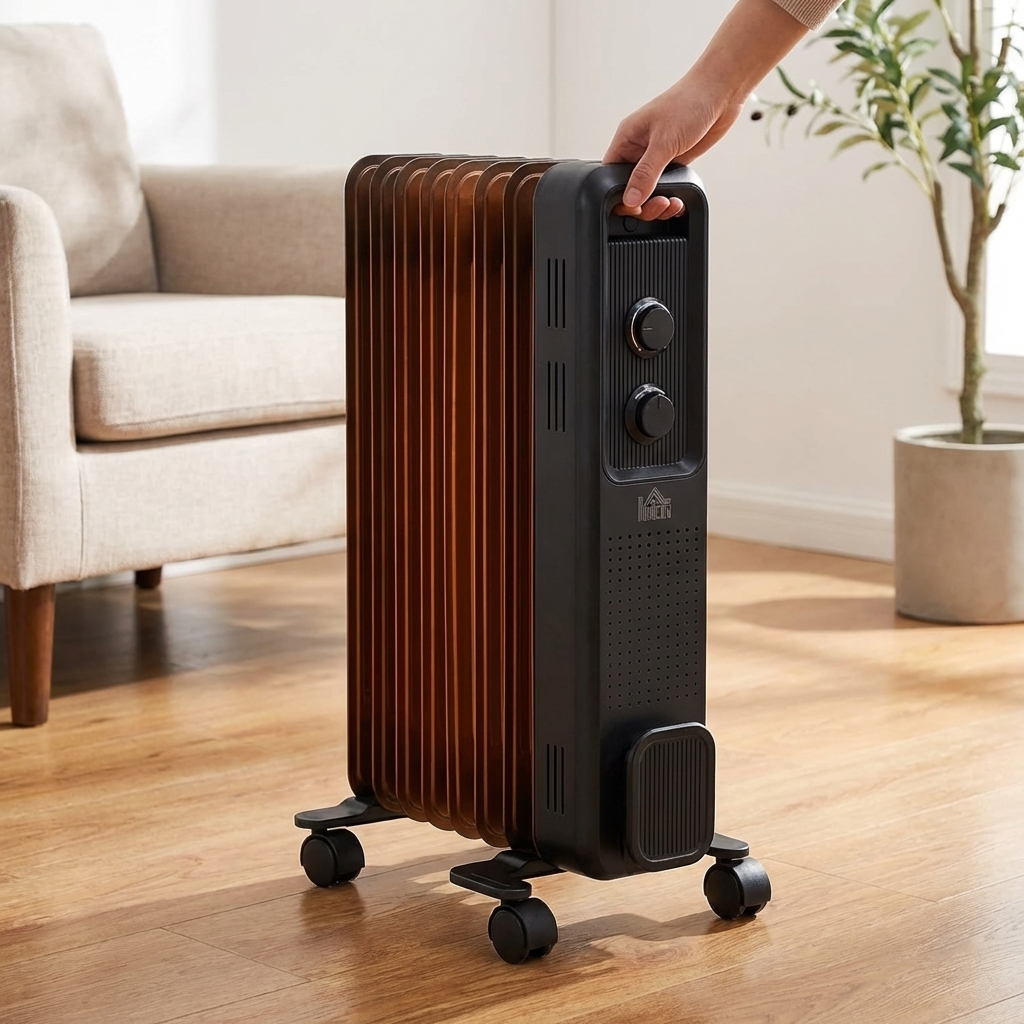
In day-to-day use, the main friction points with many portable heaters are rarely the headline wattage; they are the small handling realities. The reviewed HOMCOM heater includes wheels, which matters more than it sounds: oil-filled units have physical heft, and moving them without decent rolling support quickly becomes an annoyance. Wheels reduce the “commitment” of placing it in one spot, which can make the heater more likely to be used where it actually helps rather than where it is easiest to park.
Three heat settings can be enough, but only if the thermostat behaviour is predictable. In real rooms, the difference between “comfortable” and “too warm” can be narrow, especially in smaller spaces. A coarse control scheme can still work, yet it asks the user to accept more manual intervention—turning down, turning up, repositioning—because the heater cannot fine-tune output as delicately as some more control-heavy options.
There is also a subtle ergonomics point: controls that are easy to read and adjust at standing height tend to reduce fiddling. If a HOMCOM heater’s interface encourages quick adjustments, it becomes easier to run it “just enough” rather than defaulting to a higher setting and hoping the room settles.
Safety Behaviour and Boundary Conditions: What Changes the Risk Profile
Safety cut-off features are now common, but their real value shows up in the edge cases: cramped layouts, pets moving around, or households where someone may bump the unit while passing. An oil-filled radiator typically has a lower surface “shock” factor than some high-output exposed-element designs, but it is still a hot appliance with a meaningful footprint.
Placement is the unglamorous determinant. A HOMCOM heater becomes less forgiving when it is pushed too close to soft furnishings or when cables are routed across walkways. Not because the unit is uniquely problematic—because portable heating amplifies consequences when the room is tight. The safest setup is usually the least convenient one, and that tension is worth acknowledging when judging whether this format fits a particular home.
- It is more suitable where there is a stable, flat area and the unit can keep clear space around it without becoming a trip hazard.
- It can feel limiting in very compact rooms where the only available spot is beside textiles or behind furniture, because “technically fits” is not the same as “safely lives there.”
- Households that frequently move the heater between rooms benefit most from smooth-rolling mobility; lifting and carrying increases the chance of awkward handling.
Oil-Filled Radiator Versus Convector: The HOMCOM Heaters Trade-Off in Real Rooms
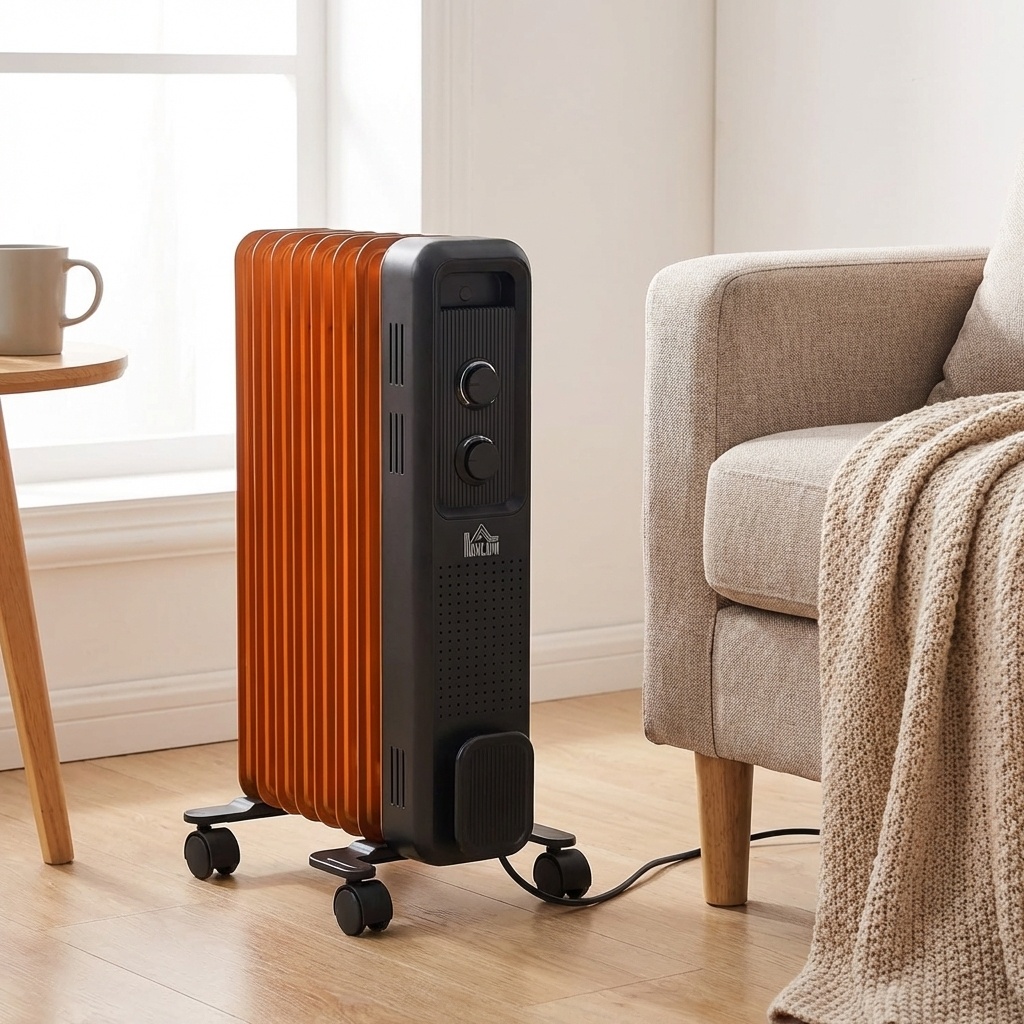
Within HOMCOM heaters, the key distinction between oil-filled radiators and convector-style units is the time profile of warmth and how that warmth moves through the room. Convector heaters generally feel quicker to register because they rely on heating air and circulating it; oil-filled radiators feel slower but can be more comfortable over longer stretches. Neither is universally “better”; the room and the usage pattern decide.
For context, the HOMCOM POWER Convector Radiator (often listed as a wall-mountable option) tends to make more sense when the priority is a faster perceived change in air temperature—especially in rooms where people come and go. The trade-off is that the comfort can feel more dependent on air movement and placement; convection needs a sensible path for air to circulate, and awkward corners can reduce the benefit.
The oil-filled HOMCOM heater reviewed here is usually easier to live with in quiet, steady occupancy. It can be the more satisfying choice when the goal is to avoid that “heater is obviously on” feeling. But it asks for patience and sensible pre-heating if the room starts very cold.
| Room and Usage Context | Oil-Filled HOMCOM Heater Tends to Suit | Convector HOMCOM Heater Tends to Suit |
|---|---|---|
| Short sessions (15–30 minutes) | Less satisfying if starting from cold; warmth builds gradually | More immediately noticeable change in air feel |
| Longer occupancy (1–4 hours) | Often more comfortable and steady once settled | Can work well, but may feel more “active” as air cycles |
| Draughty spaces | Can struggle to feel impactful unless the room is improved or pre-heated | May feel more responsive, but heat can still be lost quickly |
| Quiet environments (work, reading) | Typically a better match for low-disruption heating | Depends on airflow behaviour and placement |
Power Level and Perceived Output: Why 1500W Is Not the Whole Story
It is tempting to treat wattage as a direct promise of warmth, but with a HOMCOM heater the perceived result is shaped by insulation, ceiling height, and how much cold surface the room contains. A 1500W unit can feel plenty in a modest, reasonably sealed room, then feel surprisingly modest in a space with large windows, uninsulated walls, or constant door opening. The heater is not changing; the heat loss is.
Oil-filled radiators also “spend” some of their early output heating their own mass. That is not wasted energy—because the stored heat later smooths comfort—but it does change the first 10–20 minutes of experience. If the expectation is immediate relief, that initial phase can read as weaker performance even when the room eventually reaches a stable comfort level.
This is where a larger unit in the same family can be relevant. The HOMCOM 2000W Oil Filled Radiator variant, with additional control features, may suit rooms that consistently feel on the edge of what 1500W can handle. Not as a blanket upgrade, but as a way to reduce “always on high” operation in tougher rooms, which can be the difference between a heater that feels calm and one that constantly chases the temperature.
Noise, Air Quality Feel, and Thermal Character: The Less Obvious Pros and Limits
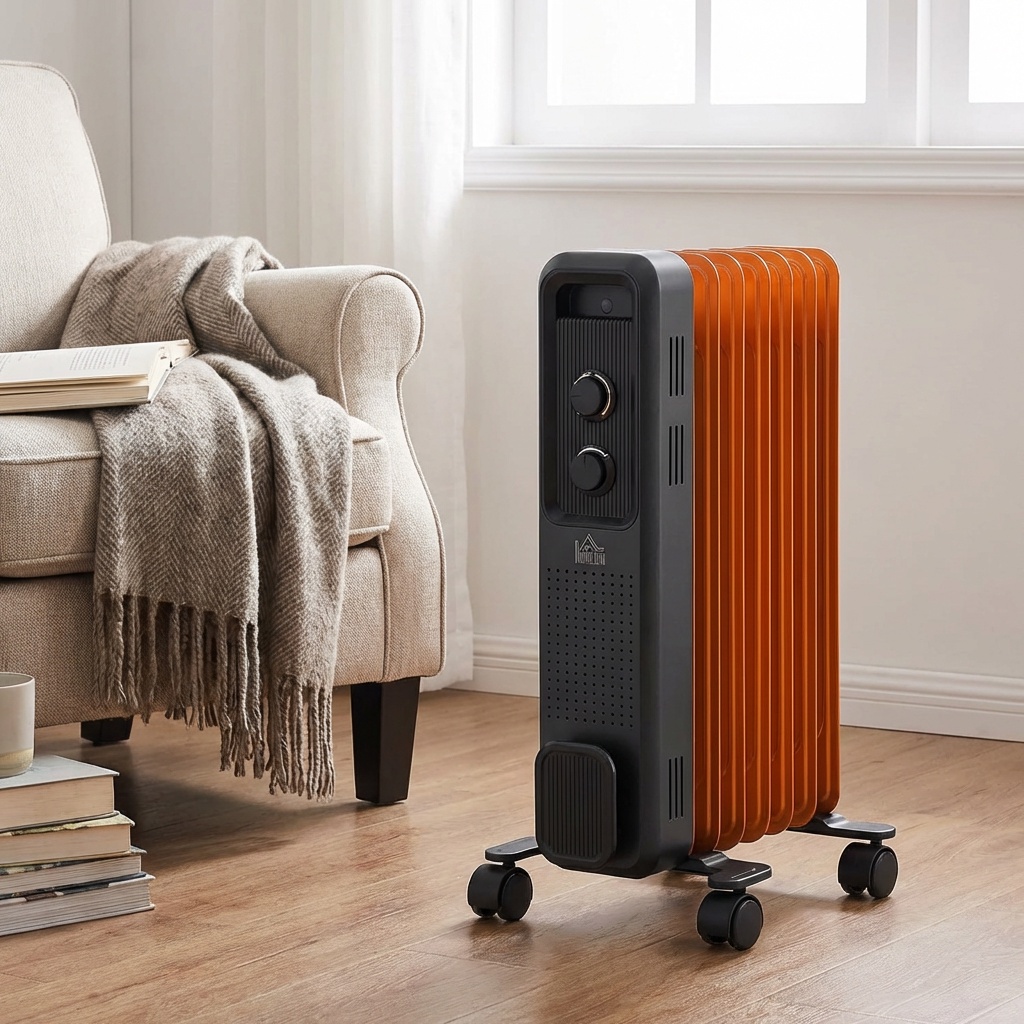
One of the quiet advantages of an oil-filled HOMCOM heater is that comfort is delivered without pushing air aggressively. In homes where dust is noticeable, or where people dislike the sensation of moving warm air, this can matter more than raw heat speed. The room feels warmed rather than “blown at.” That said, the absence of forced airflow also means the heater relies on natural circulation; if the unit is tucked behind obstacles, the warmth can stratify and feel less present where people sit.
Noise is usually a non-issue compared with fan heaters, but not always a literal zero. Thermostats can click, and expansion noises can occur as metal warms and cools. In very quiet rooms, those small sounds might be noticed, though they are typically intermittent rather than constant. For light sleepers, this can still be a deciding factor depending on how close the unit sits to the bed.
Where This HOMCOM Heater Can Feel Less Suitable
The main limitations are not dramatic flaws; they are mismatches between heater style and the job it is being asked to do. If the room is consistently cold because the building fabric is losing heat quickly, a portable HOMCOM heater can become a stopgap that runs hard without ever delivering the “finally warm” feeling. In those cases, the heater is fighting the room, not simply heating it.
It can also feel like the wrong tool when the household wants targeted warmth at a specific seat, immediately. Oil-filled radiators are better at lifting the overall room comfort than delivering instant local heat. When the expectation is direct, fast warmth on demand, convector or fan-led approaches often align better.
- Less compelling for very rapid, short-term spot heating where the user expects immediate payoff.
- Potentially limiting in large, leaky rooms where heat loss dominates and the unit must run near maximum to keep up.
- Not ideal when placement options are constrained, because blocked airflow reduces the practical reach of a radiator-style heater.
Value Signals Inside the HOMCOM Heaters Range: What the Price Usually Buys
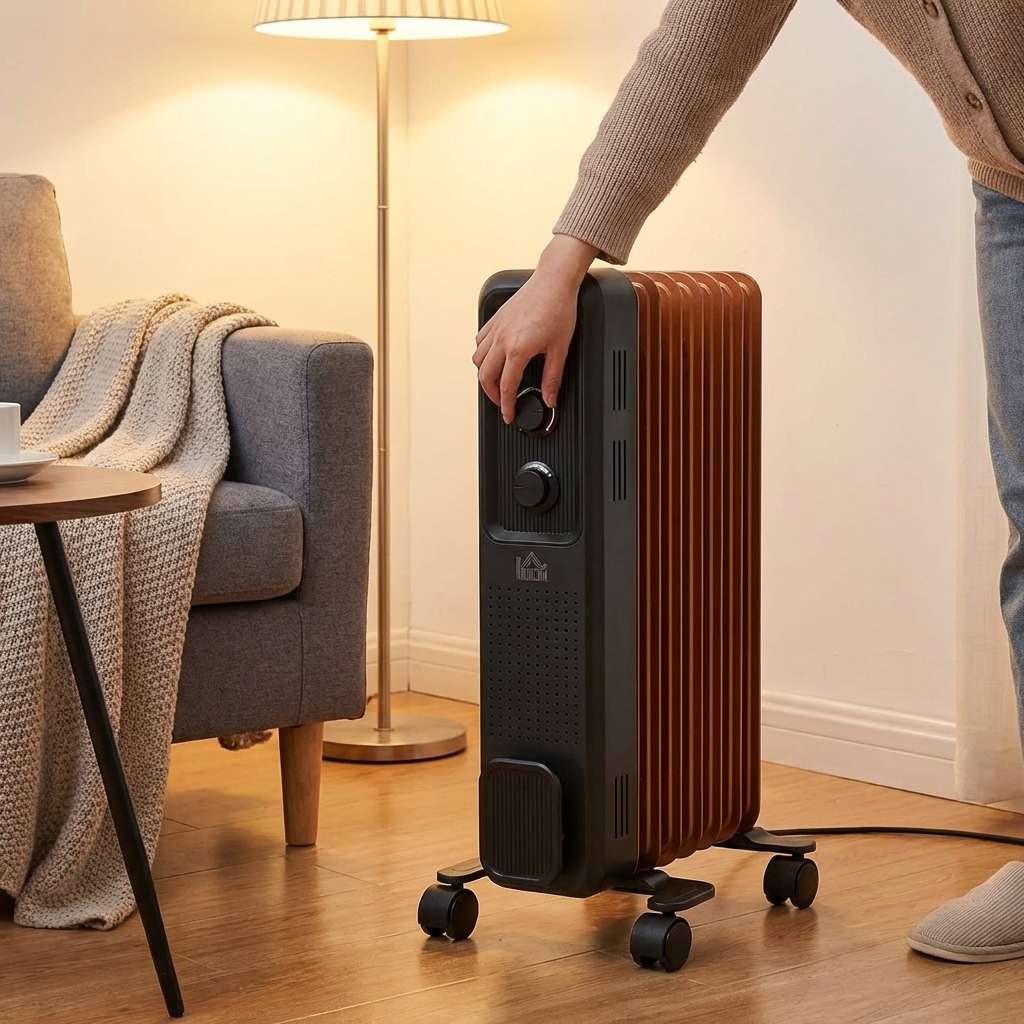
Within HOMCOM heaters, the price steps often map more to convenience and control than to a fundamentally different heating outcome. Basic units can warm a suitable room; higher-feature models tend to reduce friction—timers, displays, remotes—so the heater is easier to integrate into real life. That matters if the space is used on a schedule and the goal is to arrive to a room that is already comfortable rather than waiting for it to catch up.
For the main HOMCOM heater here, the value proposition is strongest when the buyer wants a straightforward, steady radiator-style heater with mobility and safety basics, and is not expecting app-like control or fine-grained programming. When a room’s heating needs are predictable and simple, extra control layers can be nice but not essential; when usage is irregular, those extras can meaningfully change satisfaction.
HOMCOM Heater Verdict: Where This Oil-Filled Style Earns Its Place
A HOMCOM heater in this oil-filled style makes the most sense when the goal is steady, low-fuss heat that feels consistent rather than aggressive. The main appeal is the way oil-filled radiators smooth out temperature swings: they warm up more slowly, then hold onto heat and avoid the blasty, on-off feeling that can make a room feel uneven.
That specific “slow and steady” profile is also the point that decides fit. If the room needs quick relief the moment it’s switched on, oil-filled can feel behind the pace. If the room is used for longer stretches—work blocks, evenings, overnight—this approach tends to feel more natural and less intrusive.
-
Best fit: people who value stable warmth, quieter operation, and a calmer heat profile that doesn’t constantly draw attention to itself.
-
Less ideal: anyone expecting rapid, instant warmth in a cold space, or who tends to heat a room in short bursts and then switch everything off again.
-
Practical expectation: the comfort payoff usually arrives after the unit has had time to build momentum; planning matters more than “power” on paper.
Realistic Trade-Offs With a HOMCOM Electric Heater in Daily Use
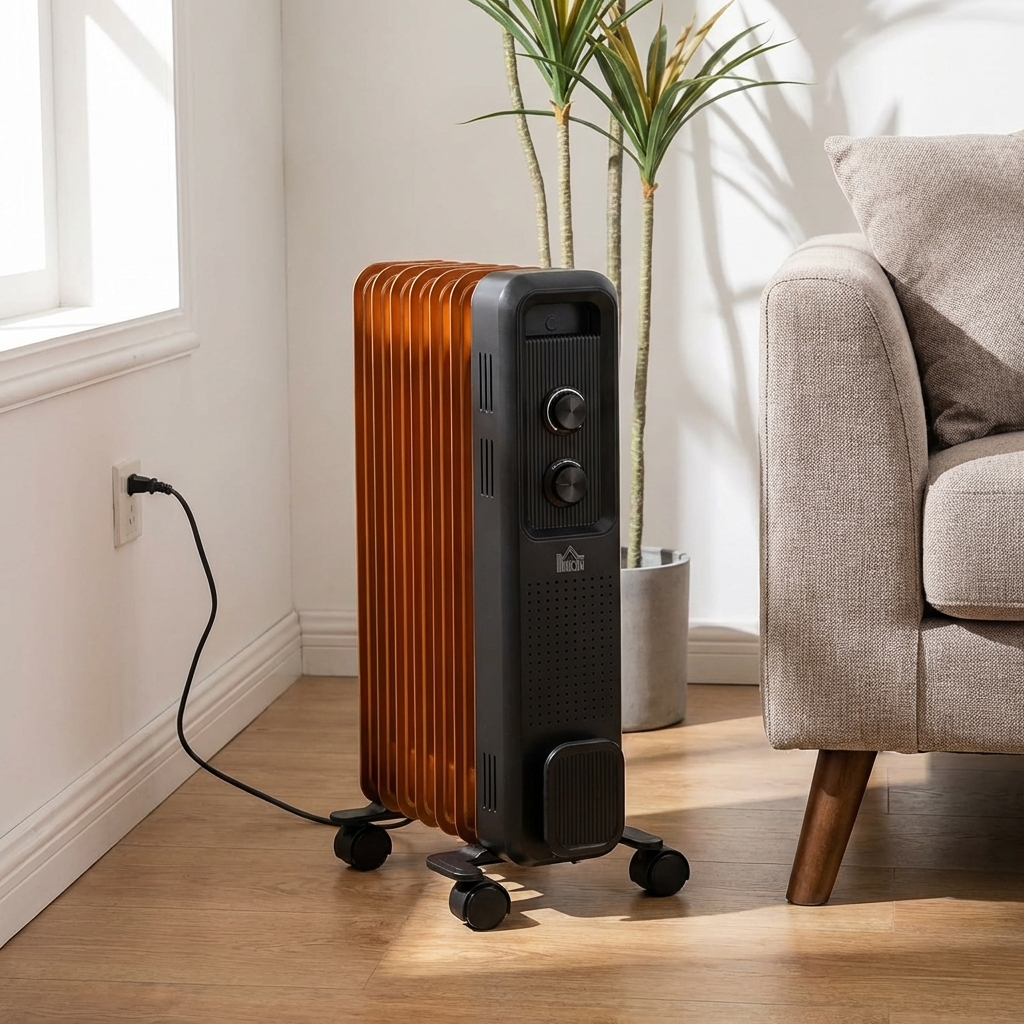
For most households, the decision comes down to tolerance for compromise: oil-filled warmth is comfortable, but it is not “nimble.” With a HOMCOM electric heater of this type, the day-to-day experience is shaped by timing, placement, and how the thermostat interacts with the room’s heat loss (draughts, thin glazing, high ceilings).
There are also a few non-negotiables that can make this style feel limiting. They are not flaws so much as the physics of the format.
-
Warm-up time: it typically needs a lead-in period before it feels like it’s properly doing the job; that’s a deal-breaker for some routines.
-
Space and clearance: it takes up floor space and needs breathing room around it; in tight layouts, it can feel like an obstacle rather than a background appliance.
-
Heat “reach”: it will not throw heat across a room the way fan-assisted units can; rooms with poor air circulation may feel patchy unless placement is thoughtful.
On the upside, this same behaviour is why many people prefer it for calmer environments. Less air movement can mean less perceived draught and less disruption—useful where concentration or sleep matters more than speed.
HOMCOM Oil Filled Radiator Positioning: When It Beats Other HOMCOM Heaters
Within the broader HOMCOM heaters range, an oil-filled radiator is usually the more “ambient” option. It can be the better choice when comfort is defined by consistency—especially if the room is occupied for hours at a time and the heater is expected to fade into the background.
Other heater formats can be more suitable when immediacy is the priority. A convector-style unit, for example, tends to feel more responsive in the first minutes, which can suit stop-start heating habits. But that faster feel often comes with a different comfort character: more noticeable cycling, more reliance on room airflow, and a heat that can feel less even in awkward spaces.
The cleanest way to decide is to be honest about the first 15 minutes of use. If those minutes matter most, oil-filled can disappoint. If the next three hours matter most, it often makes more sense.
Who Should Choose This HOMCOM Heater, and Who Should Pass
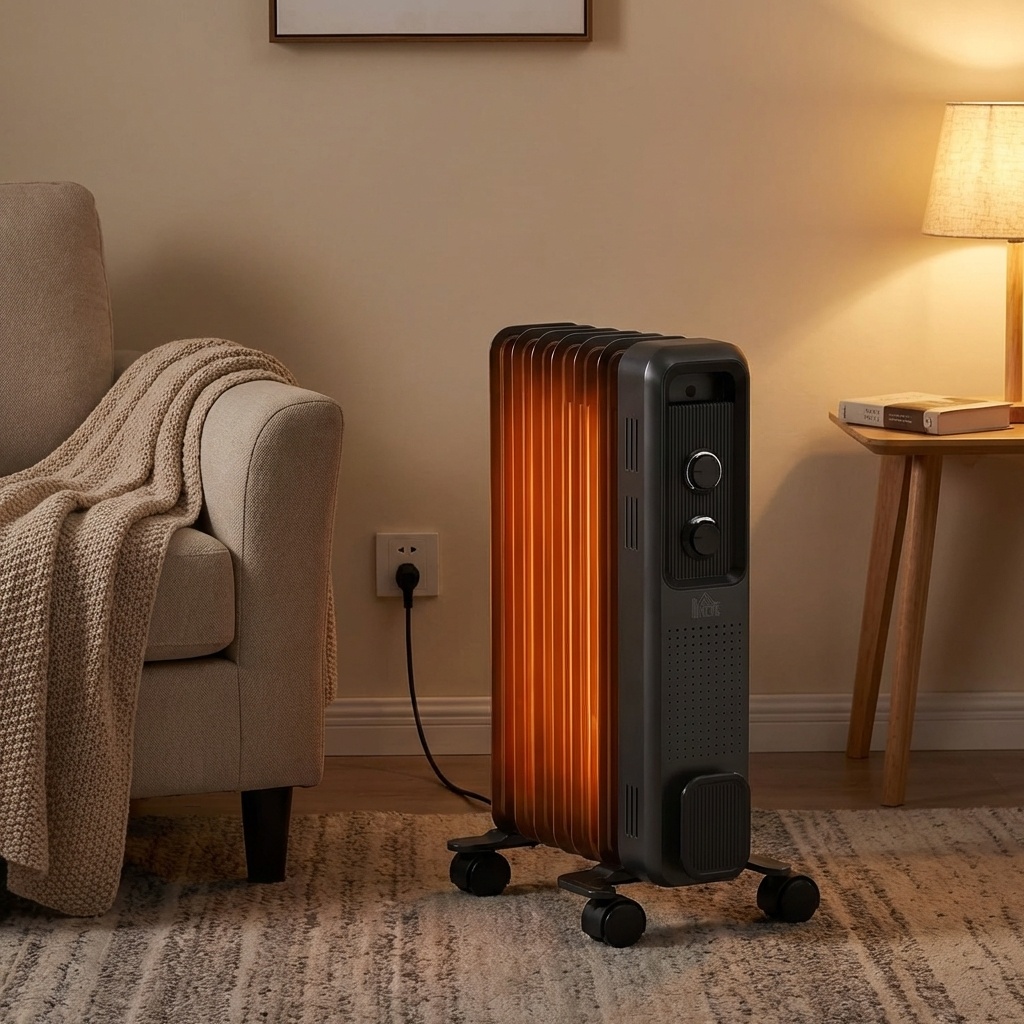
This HOMCOM heater is a sensible buy for a specific kind of home routine: predictable, longer occupancy, and a preference for quieter, steadier warmth. It also suits users who dislike the sensation of air being pushed around and want heat that feels less “mechanical.”
It may not suit households that treat heating as a quick fix—cold room, switch on, feel warmth immediately, switch off. In that pattern, oil-filled radiators can feel inefficient in practice because the user never reaches the comfort stage that justifies the warm-up time.
-
Choose it if: the room is used for extended periods, the priority is comfort over speed, and the layout allows safe clearance without the unit becoming a trip hazard.
-
Skip it if: heating sessions are short, the space is very tight, or the expectation is fast “direct” warmth rather than gradual ambient heat.
As a final expectation check: this type of HOMCOM oil filled radiator can feel impressively comfortable in the right routine, but it rarely feels dramatic. The win is steadiness, not spectacle.
FAQ: Common Questions People Have About HOMCOM Heater Searches
Is a HOMCOM Heater Better as a Quick Warm-Up Option or an All-Evening Heat Source?
Oil-filled models generally feel better as an all-evening heat source because they build warmth gradually and then maintain it more evenly. For quick warm-ups, faster-response heater types usually feel more immediately satisfying.
Why Do Some Heaters Feel Warm but the Room Still Feels Chilly?
Local warmth near the unit can be misleading if the room is losing heat quickly through draughts, poor insulation, or large cold surfaces. Even a strong heater can struggle to change overall comfort if heat loss is dominating.
Does “More Watts” Automatically Mean a Room Will Feel Warmer?
Not automatically; wattage affects potential output, but perceived warmth depends on room size, heat loss, airflow, and how long the heater runs. In real use, a well-matched heater in a manageable space often feels better than a higher-watt unit fighting a very leaky room.
What’s the Most Common Mismatch People Make When Choosing a Portable Heater?
Expecting instant, whole-room comfort from a format designed for gradual heat is a frequent mismatch. The second is underestimating how much placement and room layout affect how evenly warmth spreads.
Do HOMCOM Heaters Tend to Be Noisy?
Noise depends more on heater type than brand: fan-assisted units are usually more noticeable, while oil-filled and many convector styles can be relatively quiet. Occasional clicks from thermostats are common across many electric heaters and are not unusual in normal operation.