
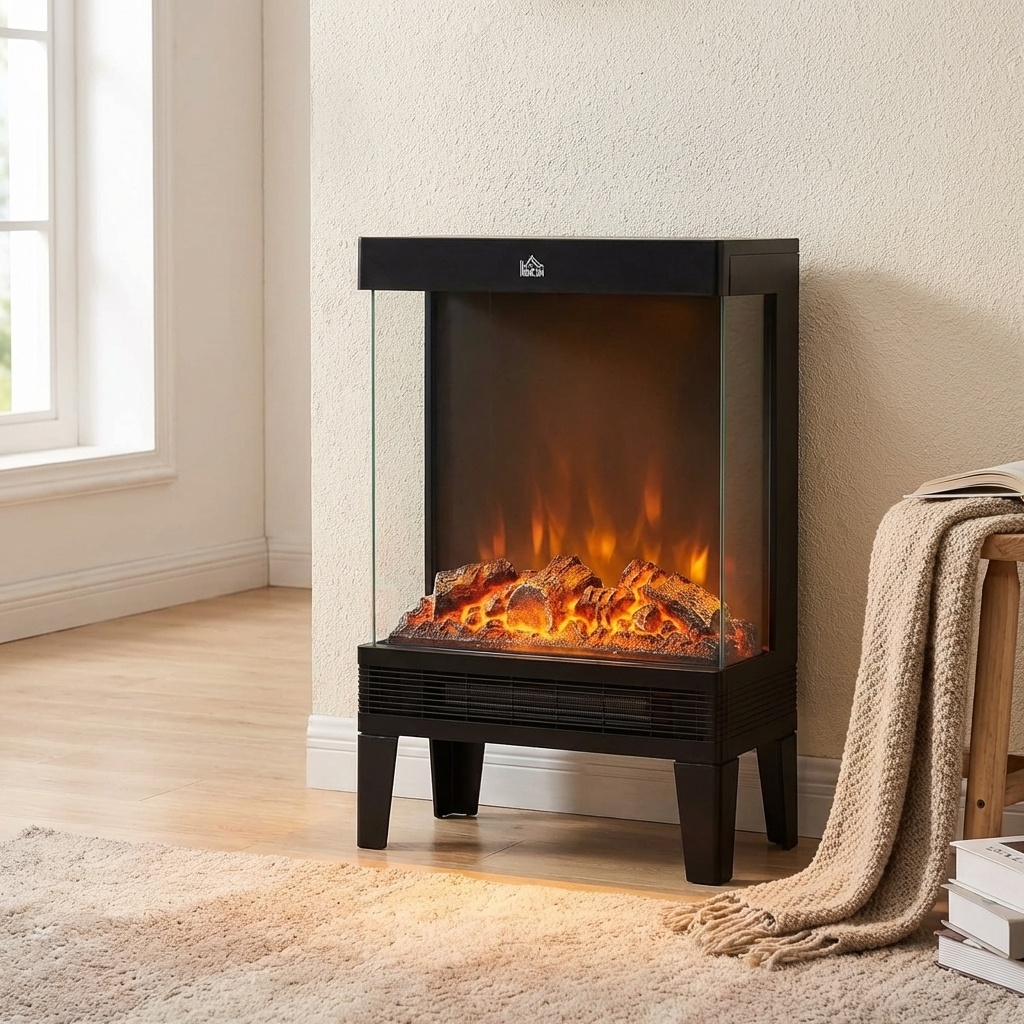
A HOMCOM electric fire like this one tends to make the most sense for people who want the fireplace look without committing to installation work, and who mainly need quick, controllable warmth in a small-to-medium room. It can feel less convincing when the expectation is “real fire” ambience or whole-home heating—different job, different tool.
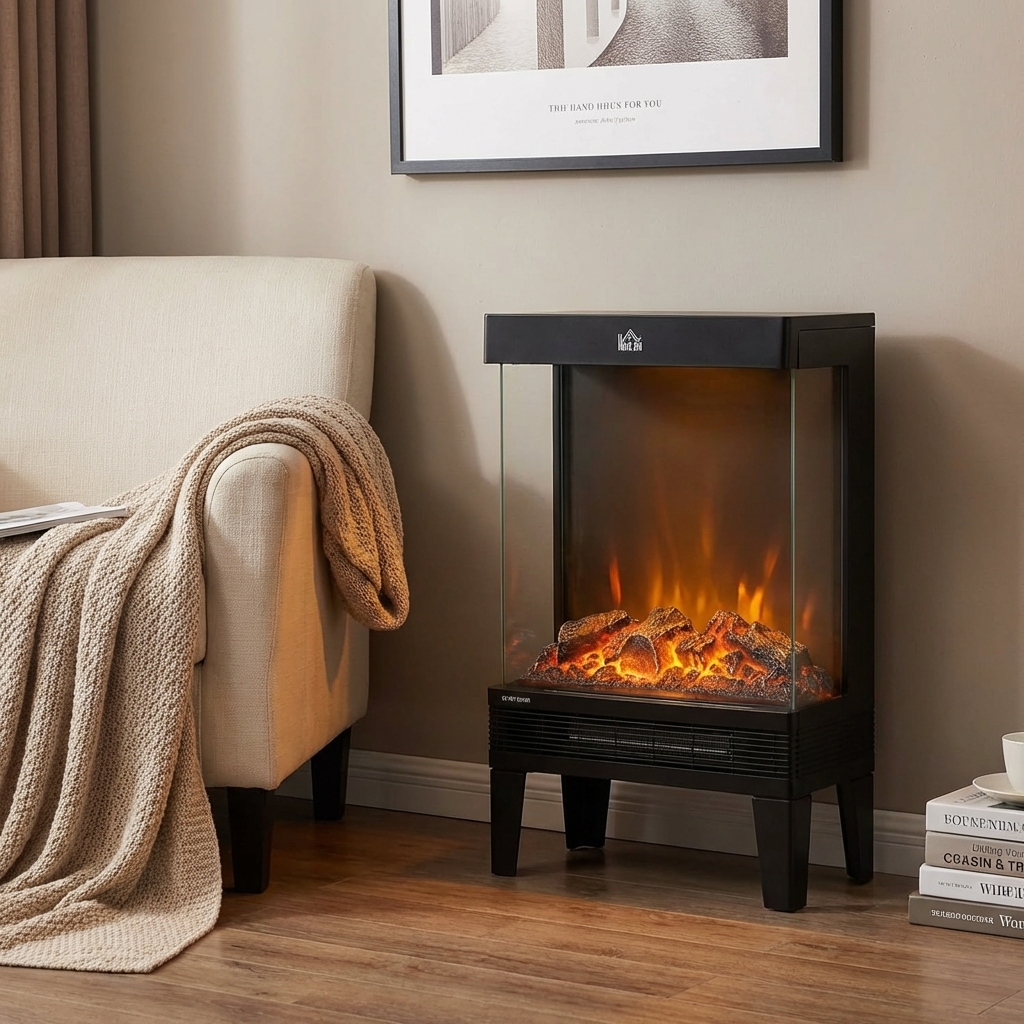
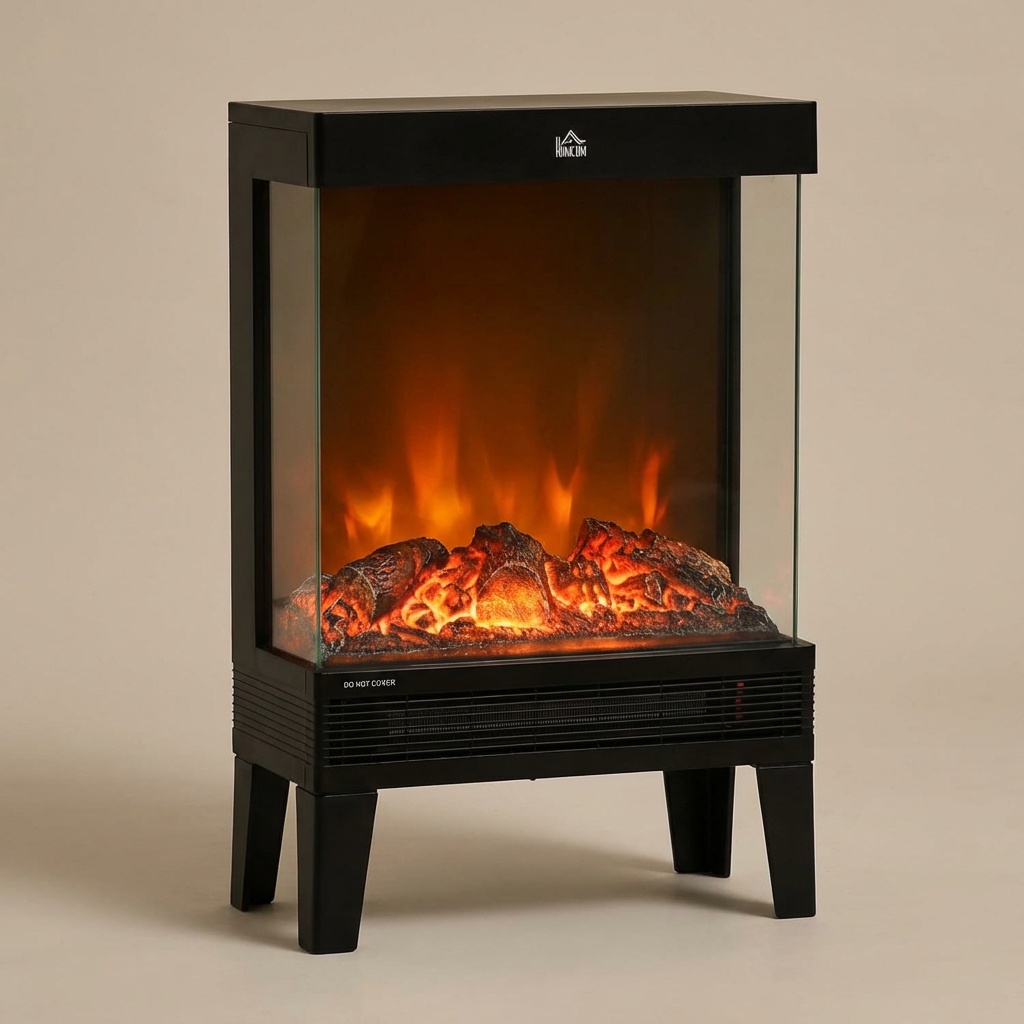
The unit under review is the HOMCOM 180° Charming Electric Fireplace Heater. The headline idea is simple: a freestanding electric fireplace heater with a visible flame effect and a two-step heat output (1000W/2000W), built around straightforward controls and basic safety cut-offs.
In furniture terms, this sits in an awkward middle ground: part heater, part visual object. That’s not a criticism. It just changes what “good” looks like. A glossy flame display means nothing if the room still feels draughty; equally, strong heat can feel intrusive if the product looks cheap in a space that’s otherwise carefully put together.
Quick Orientation: What a HOMCOM Electric Fire Is in Real Use
- What it is: a portable electric fireplace heater that behaves more like a plug-in room heater than a built-in fire.
- Why people consider it: fast warmth on demand, plus a flame effect that adds visual comfort without smoke, soot, or ventilation needs.
- Safe assumptions: it can lift comfort quickly in the zone where it sits; it is not a replacement for central heating in larger or poorly insulated spaces.
- Common mismatch: expecting deep, radiant “real fireplace” heat throughout a room—electric units mostly deliver convected warm air, and the feel is different.
Design and Presence: When the “Fireplace” Part Helps
The strongest reason to choose an Electric Fireplace Heater HOMCOM-style unit over a plain heater is that it reads as furniture, not equipment. This model leans into that with three-sided tempered glass, which matters more than it sounds. In a room where seating angles vary, a front-only flame window can become a novelty that disappears the moment the chair turns; wraparound viewing keeps the effect present from more positions.
That same glass-and-stove styling also sets a higher bar for finish. In a minimalist space, any uneven panel gap, visible fastener, or plasticky sheen becomes obvious. In a busier room—pattern, texture, mixed materials—the same object can blend in and simply do its job.
Placement also stops being a pure heating question. A HOMCOM electric fireplace that looks like a stove invites being placed where it can be seen, which is not always where heat works best. Tucked behind furniture, the flame effect is wasted; pushed into a walkway, it becomes a daily irritation. The best fit is usually a clear sightline with some breathing room around it, so warm air can circulate without feeling blocked.
Heat Output and Control: Realistic Expectations at 1000W/2000W
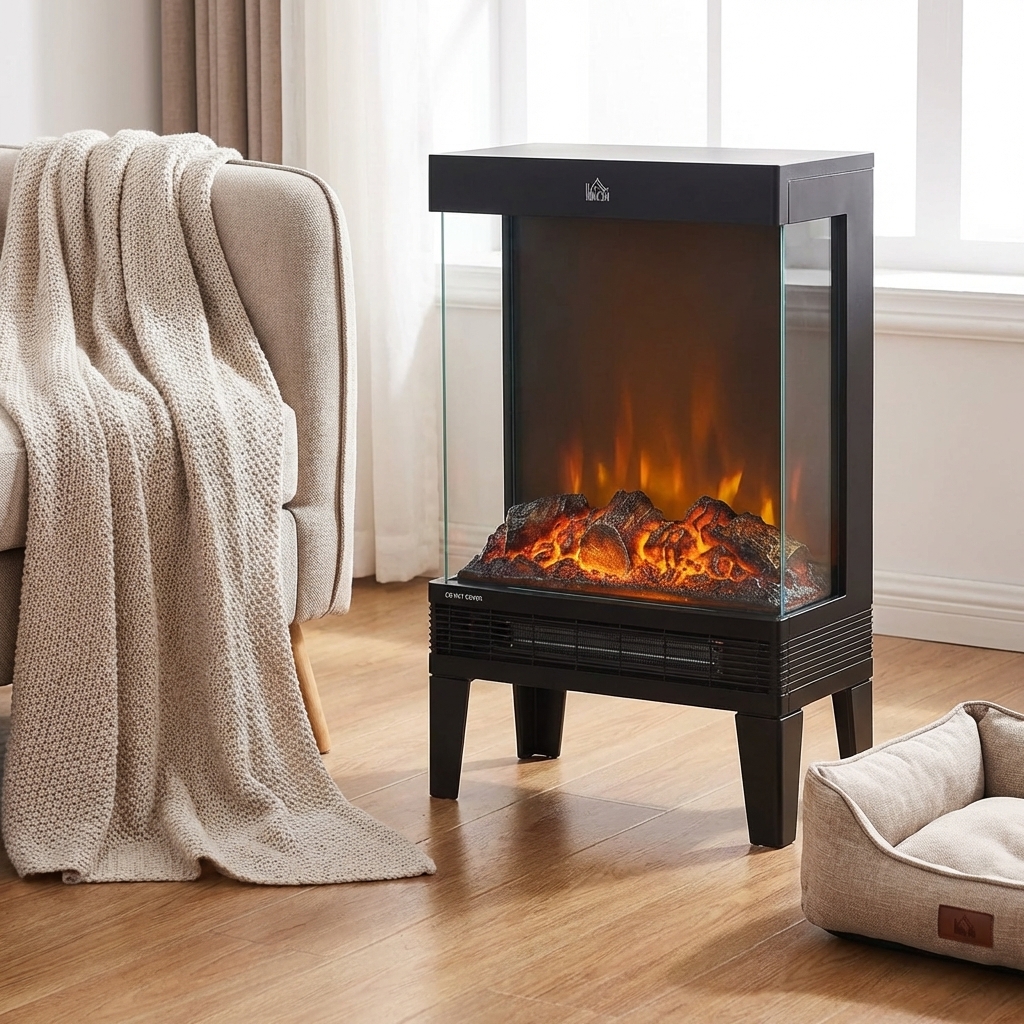
Two-stage power—1000W and 2000W—is a practical range for a freestanding electric fireplace heater. At the higher setting, the “quick comfort” effect is the point: taking the edge off a cold room while working, reading, or watching television. The lower setting often works better once the room has stabilised, or when the goal is gentle background warmth rather than a noticeable blast of hot air.
The stepless temperature control is the detail that can either feel genuinely useful or basically irrelevant, depending on expectations. If the room temperature swings a lot (draughts, older windows, doors opening frequently), fine control helps dial in a tolerable baseline without constantly flipping between modes. If the space is already stable, the difference between “fine control” and a simpler dial can be hard to feel in day-to-day use.
One limitation that tends to surprise people new to this category: 2000W sounds substantial, but it is still a room-scale tool. In open-plan layouts or rooms with high ceilings, the heat can gather in the wrong places, and the user ends up chasing comfort by turning it up—often with diminishing returns.
Noise and Evening Comfort: “Quiet” Has a Context
Electric fireplace heaters are rarely silent when heat is on, because warm air movement typically involves a fan. “Quiet” usually means the sound is steady and not harsh, rather than absent. For daytime use, that’s often a non-issue. For evening use—especially in a calm room where the flame effect is meant to feel relaxing—any fan note becomes more noticeable.
The practical way to frame this HOMCOM electric fire is: it is likely to be acceptable if the room already has a little ambient noise (television, conversation, general household sound). It may feel more intrusive in a very quiet bedroom scenario, where even a modest fan can become the loudest thing in the room.
Safety and Day-To-Day Handling: Where Overheat Protection Fits
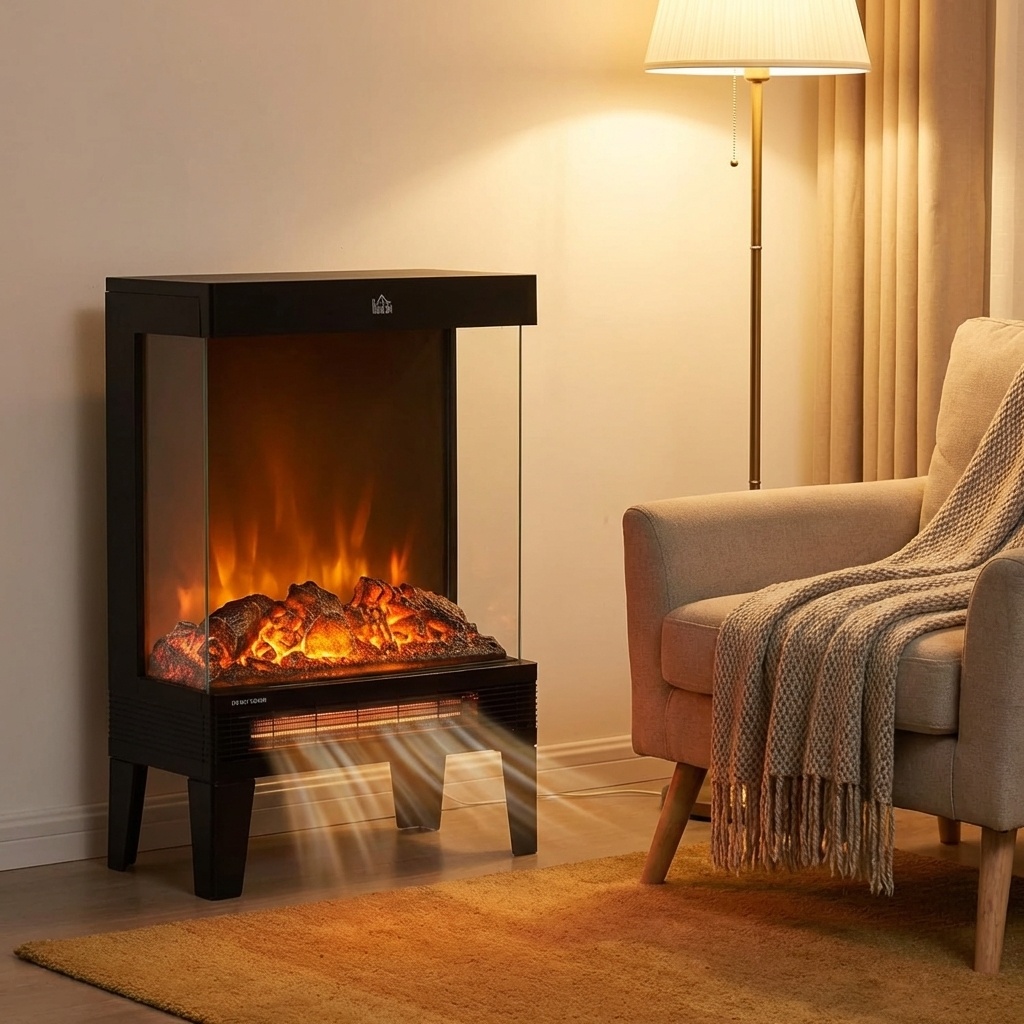
Overheat protection is not a “bonus”; it is a baseline expectation for this kind of heater, especially one that looks like furniture and may be used in lived-in spaces. The value is mostly in reducing the consequences of imperfect real life: a throw draped too close, a pet bed placed nearer than intended, a room that warms faster than expected.
That said, safety features do not cancel out basic placement discipline. A HOMCOM electric fire still needs clear airflow and a sensible perimeter. The stove-style look can tempt people to treat it like a decorative object that happens to warm the room. In practice, it should be treated like a heater first, visual feature second.
Who This Type of HOMCOM Electric Fireplace Usually Suits
This is less about taste and more about how homes actually get used. A HOMCOM freestanding electric fireplace heater tends to fit best when it is asked to do a specific, bounded job.
- Works better for targeted comfort in a defined area, where people sit relatively close and want warmth quickly.
- Often suits renters or anyone avoiding permanent changes, because the appeal is plug-in simplicity and portability.
- Fits rooms where the flame effect will be seen regularly—otherwise a simpler heater can make more sense.
- Can feel limiting for large, open spaces or for users chasing the heavy, radiant feel of a traditional fireplace.
Heat Delivery and Room Feel With a HOMCOM Electric Fire
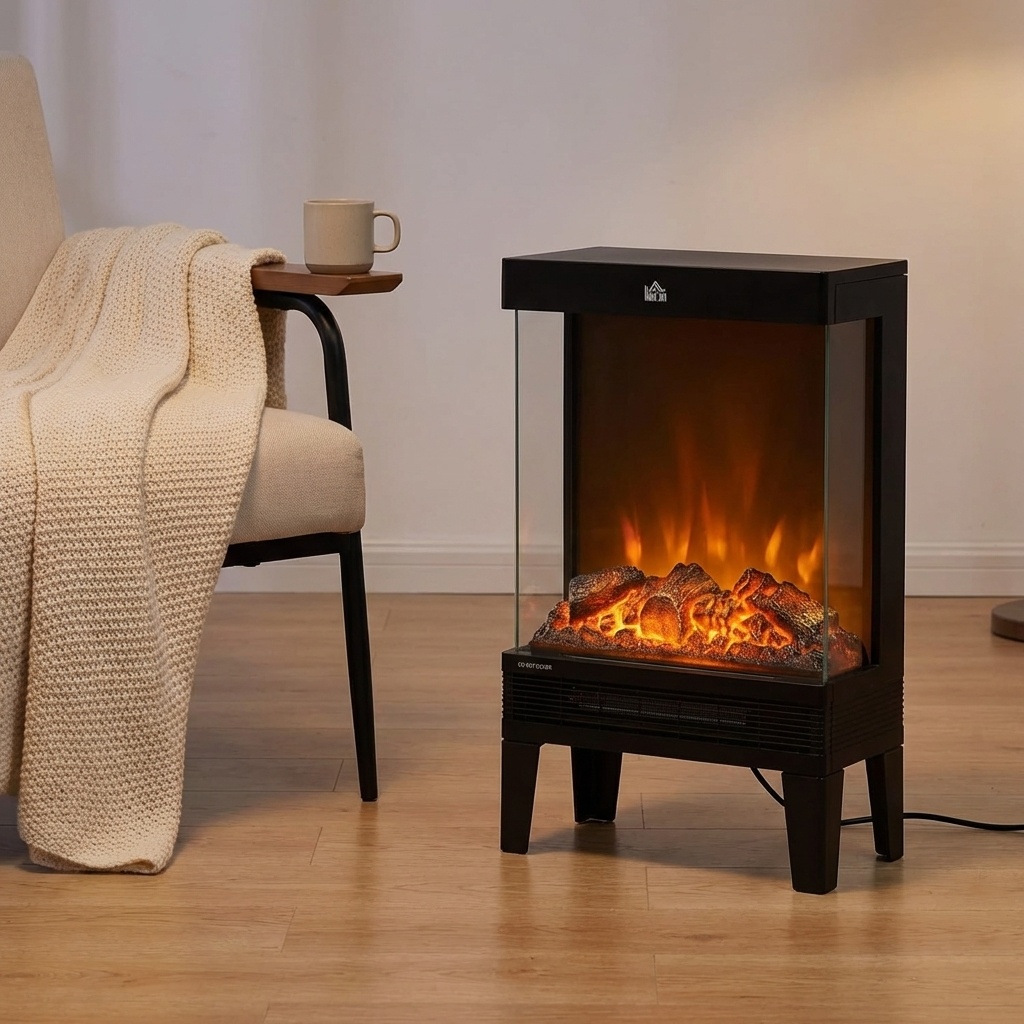
In day-to-day use, this HOMCOM electric fire behaves like most fan-assisted electric heaters: it can lift the perceived comfort of a small-to-mid room quickly, but it will not create the slow, enveloping warmth associated with a true masonry fireplace. The practical difference is how the heat “lands” in the space. The output is directional and noticeable near the unit, then softens with distance and air movement.
The two power steps (1000W/2000W) are the kind of control that matters more than it sounds. 2000W is useful for the first 10–20 minutes when the room is cold; 1000W suits maintenance once the space has stabilised, or when the heater is placed closer to seating where full power can start to feel too direct. If the goal is background warmth while working or watching television, the lower setting often feels calmer and less drying.
Placement is what decides whether this category feels “effective” or merely decorative. A freestanding unit like this works best when it is not boxed into a tight alcove that traps airflow and makes the fan sound more obvious. It also benefits from being kept away from draught paths (hallway lines, external doors), where the warm air gets stripped away before it can raise comfort.
Flame Effect and 3-Sided Glass: Atmosphere Versus Practical Compromises
The LED flame effect is the key reason people consider a HOMCOM electric fireplace rather than a plain heater. In real rooms, the illusion is strongest when ambient lighting is moderate and the unit sits at eye level from typical seating. Under bright overhead lighting, the flame can read flatter and more “screen-like”; in dimmer conditions it becomes more convincing, especially when the surrounding décor is not overly reflective.
The 3-sided tempered glass is a genuine design advantage because it widens viewing angles and helps the unit feel less like a box pointing in one direction. At the same time, glass introduces a maintenance reality: fingerprints, dust and fine household residue show quickly, particularly on the side panels. That is not a flaw so much as a trade-off—visual openness tends to demand more frequent wipe-downs to keep the effect crisp.
Tempered glass also changes how the unit is “read” in a family home. It is generally more robust than standard glass, but it still invites a bit more caution around knocks, tight traffic routes and low-level placement where feet, bags or vacuum cleaners tend to clip corners.
Noise Profile and the “Quiet” Claim in Real Use
Two nuances matter here. First, hard surfaces amplify: bare floors and minimal soft furnishings reflect the higher-frequency part of the fan noise. Second, proximity changes perception: a unit placed close to the listener can feel “louder” even if measured output is unchanged.
- For reading or focused work, the heater tends to be least intrusive when positioned off-axis rather than directly in front of the seating position.
- For sleep-sensitive environments, it is worth expecting some audible airflow, especially on the higher heat setting.
- If the room is echo-prone, adding textiles often does more for perceived quietness than moving the unit a few centimetres.
Control Feel: Stepless Temperature Dial in Practice
The stepless temperature control is a practical style of interface because it avoids the “too hot / too cool” seesaw that can happen with coarse, click-step controls. The flip side is that it relies on the user’s touch and patience: the sweet spot is found by small adjustments and a few minutes of waiting for the room to respond, not by setting a precise number and forgetting it.
This kind of control suits people who are present in the room and willing to fine-tune. It can feel less satisfying for those who want repeatable settings across days, or who expect thermostat-like behaviour without monitoring. In a space where the temperature swings—sun through a window, intermittent door opening—the dial can still work well, but it asks for occasional correction.
Safety Systems and Where They Matter Most
Overheat protection is one of those features that only becomes visible when something goes wrong—blocked airflow, close placement to soft furnishings, or a room that is simply pushing the unit hard for long periods. In that sense it is most relevant for households that treat an electric fire as a regular heat source rather than occasional ambience.
That said, safety systems should not be treated as permission to ignore placement discipline. If the unit is used in a tight corner, near drapes, or with objects accidentally leaning against it, performance can become inconsistent and the user experience degrades before any protection system intervenes.
Build, Materials and Everyday Handling
The stove-style form and metal bodywork typically feel more “furniture-like” than plastic-bodied heaters, which helps the unit sit comfortably in living spaces. The 3-sided glass contributes to that premium visual language, but it also means the unit looks best when it is kept clean and when cable management is tidy—visible trailing cables can undermine the intended fireplace impression quickly.
Freestanding models bring a subtle handling question: how often will it be moved? If it is repositioned frequently between rooms, the practical priorities shift toward stable footing, manageable weight and a predictable grip point. If it is essentially stationary, the priority becomes how well it visually integrates and whether the footprint fits the intended spot without forcing awkward furniture spacing.
Where This HOMCOM Electric Fire Fits Best—and Where It Starts to Feel Limited
This HOMCOM electric fire tends to make the most sense for people who want a combined visual focal point and a functional boost of warmth, without the complexity of installation. It is especially well-matched to smaller rooms, rented homes, and spaces where adding a fireplace look would otherwise require structural work.
Limitations show up when expectations drift toward whole-home heating or “set-and-forget” thermostat behaviour. It can also feel underwhelming in very large, open-plan areas where warm air disperses faster than the unit can meaningfully change comfort at seating distance.
- It fits well when the goal is targeted comfort in a defined sitting zone, not uniform temperature across multiple connected spaces.
- It suits households that value the LED flame effect as part of the room’s mood, rather than treating visuals as secondary.
- It becomes less convincing as the main heat source in draughty rooms or high-ceiling spaces where heat stratifies above head height.
Value Signals in the HOMCOM Electric Fire Category Without Turning It Into a Catalogue
Within the broader Electric Fireplace Heater HOMCOM search, the real decision lever is rarely a single headline feature; it is how the unit behaves under the specific constraints of the room. The combination of 3-sided viewing and a compact freestanding format leans toward lifestyle integration—something that can sit in a living room without looking purely utilitarian—while still offering the basic 1000W/2000W practicality expected from an Electric Fireplace Heater.
For buyers who are mainly chasing heat-per-pound and do not care about flame visuals, a simpler heater can feel like a cleaner choice. For those who want the “fireplace moment” as well as warmth, the HOMCOM Electric Fireplace Heater with LED Flame Effect concept is the point—and this model’s design choices are aligned with that priority.
One reference point for the specific listing used here is the HOMCOM 180° Charming Electric Fireplace Heater, which is best judged on how convincingly it balances atmosphere, manageable fan heat, and day-to-day cleanliness in the intended room.
Editorial Verdict, Fit, and Realistic Expectations
Where This HOMCOM Electric Fire Feels Like a Sensible Choice
This HOMCOM electric fire makes the most sense for spaces where the priority is controllable, on-demand warmth with a strong visual element, without the commitment and disruption that comes with built-in heating features. Its appeal is practical: quick heat, a calm flame-style effect, and a format that can be positioned where it’s needed rather than planned into the room months in advance.
In day-to-day use, it tends to suit people who value predictability over “character.” The heat output is straightforward, and the overall experience is more about creating a comfortable zone than transforming an entire home’s thermal performance.
It is a good fit when the decision hinges on these conditions:
- Controlled comfort matters more than whole-home heating, meaning the goal is to take the edge off a room rather than replace a primary system.
- Visual ambience is part of the brief, but the expectation is a clean, consistent effect rather than a fully authentic flame presence.
- The room benefits from a heating option that can be relocated without tradespeople, permanent modifications, or planning constraints.
- Noise sensitivity is moderate: quiet operation helps, but complete silence should not be assumed in any powered heating unit.
Contexts Where a HOMCOM Electric Fire May Feel Limiting
The main mismatch happens when expectations drift toward “central heating substitute” or when the aesthetic is expected to read like a high-end focal point from every angle and distance. This category of unit is about convenience and controllability; it rarely satisfies users who want depth, mass, and the visual complexity associated with premium installations.
A few practical limitations are worth treating as decision filters rather than afterthoughts:
- If the space is very open-plan or poorly insulated, the perceived impact can feel localised, even when the unit is performing normally for its class.
- If the room layout forces the unit into a visually awkward position, the flame-style effect can become more of a background feature than a true centrepiece.
- If there is a strong preference for tactile warmth that builds slowly and lingers, the “on/off” character of electric heating can feel less satisfying than slower, more radiant sources.
- If the household already runs close to the limit on electrical circuits in a given area, the practicalities of power draw become a planning issue, not a footnote.
What “Good Performance” Looks Like in Real Rooms
With a HOMCOM electric fire, strong performance is usually felt as speed and manageability: warmth arrives quickly, the room becomes more comfortable sooner, and the output can be adjusted without guesswork. That said, comfort is not only about watts; it is also about airflow patterns, where people sit, and whether the heat is being asked to fight cold surfaces and draughts.
Realistic expectations look like this: a noticeable improvement in comfort within a defined area, plus a consistent visual effect that reads well in normal lighting. The unit is less convincing when asked to solve structural room issues (heat loss, persistent damp chill, or large temperature gradients), because those are building problems, not appliance problems.
Verdict: Who Should Choose This HOMCOM Electric Fire and Who Should Pass
This HOMCOM electric fire is best treated as a practical comfort upgrade with an ambience layer, not as a statement installation. It is a sensible buy for someone who wants a straightforward electric heating option that also changes the mood of a space, and who values ease of placement and simple control over premium realism.
It is less suitable for anyone expecting it to heat multiple connected areas effectively, or for those who want the visual presence to carry a room in the way a larger, more architectural solution can. If the goal is targeted comfort, predictable operation, and a tidy visual feature, this type of unit fits. If the goal is whole-space transformation, it will feel like a compromise.
FAQ: HOMCOM Electric Fire Search Questions That Come Up Before Buying
Is a HOMCOM Electric Fire Meant to Replace a Room’s Main Heating?
Typically no; it is better viewed as supplemental heat that improves comfort in the area where people actually spend time. It can reduce reliance on other heating in milder conditions, but expectations should stay anchored to localised warmth.
Why Do Electric Fireplace-Style Heaters Feel Warm in One Spot but Not Across the Whole Room?
Air movement, insulation, and room geometry matter as much as rated output. In larger or draughtier rooms, heat disperses quickly and the “comfort zone” stays closer to the unit.
Will the Flame-Style Effect Look Convincing in Everyday Lighting?
It usually reads best at typical viewing distances and when it is not competing with strong direct daylight. It should be judged as a consistent visual feature rather than a fully natural flame experience.
Are These Units Generally Noisy?
Most create some audible presence because they move air and run internal components. In a quiet room it can be noticeable, but it tends to blend into normal household background sound for many users.
What Is the Most Common Reason People Feel Disappointed With This Type of Heater?
The biggest issue is expectation mismatch: asking a compact electric unit to heat like a primary system, or expecting premium visual depth at entry-level positioning. When judged as targeted comfort plus ambience, satisfaction tends to be higher.