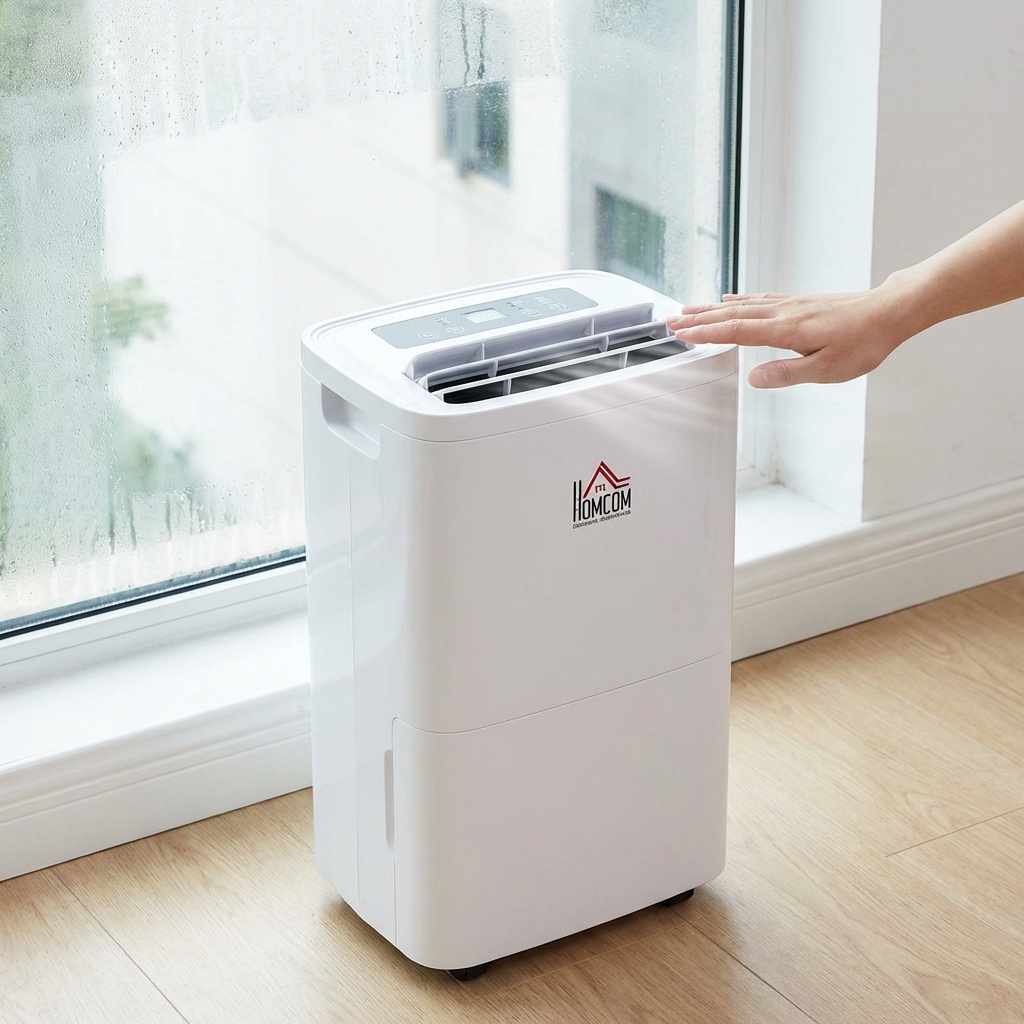
The HOMCOM dehumidifier in the 12L class tends to make the most sense for homes that feel persistently clammy rather than intermittently damp. It is a pragmatic, space-efficient approach to moisture control, but expectations need to be calibrated: it can improve day-to-day comfort and reduce condensation patterns, yet it will not “solve” a building that is fundamentally under-ventilated.
This review uses the HOMCOM 12L/Day Dehumidifier as the main reference point, because it sits in the middle of the range many households consider before jumping to larger, louder units. The interesting question is not whether a dehumidifier removes water—most do—but whether this particular balance of capacity, tank size, sensing, and day-to-day handling fits real routines.
Quick Orientation (So the Rest Makes Sense)
-
A HOMCOM dehumidifier is a portable moisture-removal unit aimed at everyday domestic damp, condensation, and musty-feeling rooms.
-
People typically encounter it when they are searching for a practical fix for recurring window condensation, slow indoor drying, or that “never quite fresh” air in certain spaces.
-
A safe assumption: the unit can reduce humidity in a closed or semi-closed room when sized sensibly. A misleading assumption: it replaces ventilation, insulation fixes, or source control.
What This HOMCOM Dehumidifier Is (And What It Is Not)
The core promise of the HOMCOM dehumidifier is straightforward: pull moisture out of the air and collect it in a tank, using a humidity sensor to avoid running harder than needed. In practice, that last part—the sensor-led behaviour—matters more than the headline “litres per day” figure. A unit that cycles sensibly can feel quieter, less intrusive, and less wasteful over a week of use, even if the nominal capacity looks similar on paper.
What it is not: a silent appliance, a set-and-forget building remedy, or a guarantee against mould in every context. Where mould is already established, moisture removal supports prevention and comfort; it does not replace cleaning, airflow, and addressing cold surfaces that trigger condensation.
Why The 12L Class Is Often The Decision Point
Most buyers hovering around a HOMCOM portable dehumidifier are trying to avoid two common frustrations: a small unit that never catches up, and a large unit that dominates the room—visually, acoustically, and in running habits.
A 12L/day-type spec is often chosen because it suggests enough headroom for routine damp without drifting into “utility-room appliance” territory. The trade-off is subtle. If the space is larger, leaky, or frequently has doors open, performance can slide from “noticeable improvement” to “always running, still feels damp.” That is not a defect; it is a sizing mismatch that shows up in electricity use and noise tolerance.
Real-World Expectations: What Changes First, What Takes Longer
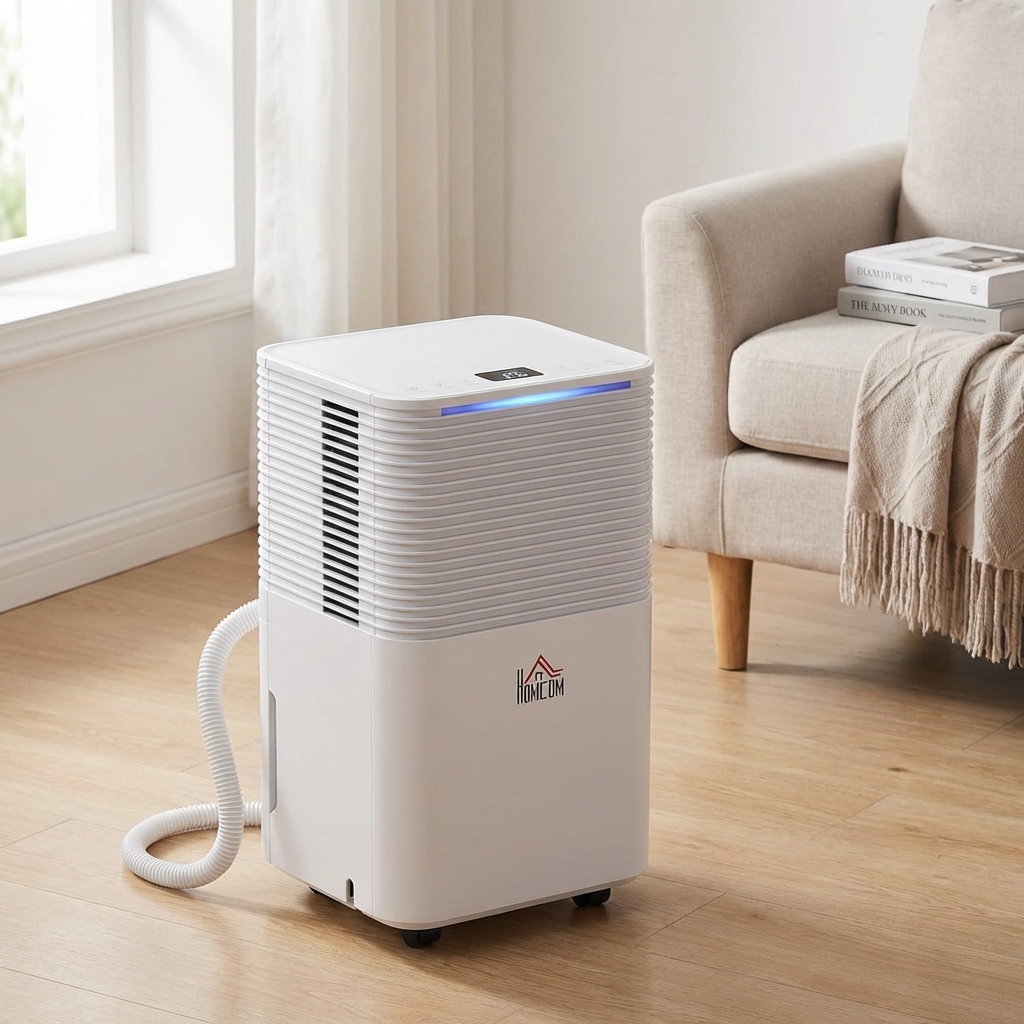
With a HOMCOM dehumidifier, the earliest change is usually the feel of the air—less clammy, less that cold-moist sensation that makes a room seem cooler than it is. Condensation behaviour can improve quickly too, but not uniformly. Windows may clear sooner than corners, and wardrobes may still hold a stale note if air is not circulating.
What tends to take longer is the “background” effect: fabrics, soft furnishings, and the general moisture load of the room. A unit can pull water from the air efficiently while the room continues to release moisture from walls, floors, and textiles. That is why short, occasional runs can disappoint in persistently damp spaces; steadier, sensor-led control is often the more realistic pattern.
Controls, Modes, And The Day-To-Day Handling That Actually Matters
Specs like timers and multiple modes sound like marketing until they collide with routine. A dehumidifier that is easy to live with tends to get used correctly. One that is fiddly often ends up switched on only when conditions are already uncomfortable.
For this HOMCOM dehumidifier review, the key handling questions are less about the number of modes and more about whether the interface supports sensible behaviour:
-
Humidity targeting: clear setpoints make it easier to avoid over-drying (which can feel harsh) while still preventing that damp “edge” in the room.
-
Tank management: a smaller tank can be fine if emptying is easy and predictable; it becomes irritating if it fills at awkward times or the full-tank behaviour interrupts overnight running.
-
Noise tolerance: many households accept a steady hum in a hallway or spare room, but not in a bedroom. Whether “sleep mode” is genuinely sleep-friendly depends on sensitivity and placement, not the label.
People searching for a HOMCOM dehumidifier manual or HOMCOM dehumidifier how to use are often trying to solve these practical frictions: setting a target humidity that makes sense, understanding what the sensor is doing, and choosing a mode that does not run unnecessarily.
Where This HOMCOM Dehumidifier Typically Fits Well
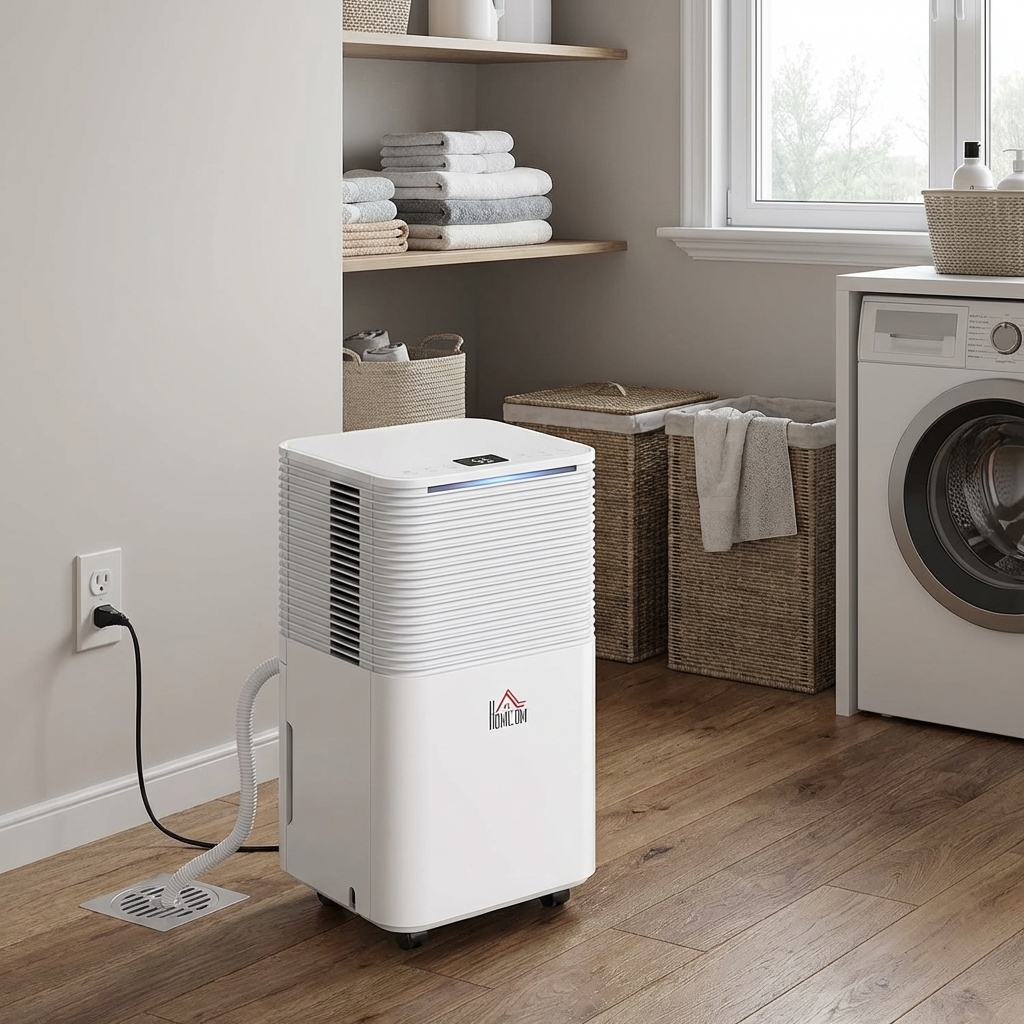
This style of HOMCOM dehumidifier tends to work best when the goal is consistent damp management rather than emergency drying. It often fits homes where a single problem area drives the purchase—yet the unit may be moved between spaces depending on the week.
-
Rooms that feel persistently “heavy” despite heating, especially when outdoor humidity is high.
-
Condensation-prone periods where moisture spikes are predictable and routine control helps more than occasional blasting.
-
Households wanting a moderate, domestic-looking unit rather than an oversized appliance that feels industrial in a living space.
That said, if the situation involves very high moisture generation, constant door opening, or a large open-plan layout, the decision can shift: either accept longer run times, or look at a higher-capacity option within the same brand range, such as the HOMCOM 16L/Day Portable Dehumidifier, where the practical difference is often less about peak numbers and more about how quickly the room returns to a comfortable baseline.
Early Comparison Context: HOMCOM Dehumidifier vs Smaller Capacity
Most “Dehumidifier HOMCOM” searches eventually circle back to the same fork in the road: pay less for a smaller capacity unit, or pay more for headroom that may only be needed occasionally. The smaller option can be the more rational choice when the damp is mild and the room is compact; it can also feel limiting when the unit is asked to do two jobs at once—keep humidity stable and help with faster drying.
As a reference point inside the range, the HOMCOM 10L/Day Dehumidifier is the sort of alternative that can make sense in tighter spaces or where noise and footprint matter more than speed. The 12L class tends to justify itself when the household would rather run the unit less aggressively for the same comfort outcome.
What Day-To-Day Moisture Control Looks Like With a HOMCOM Dehumidifier
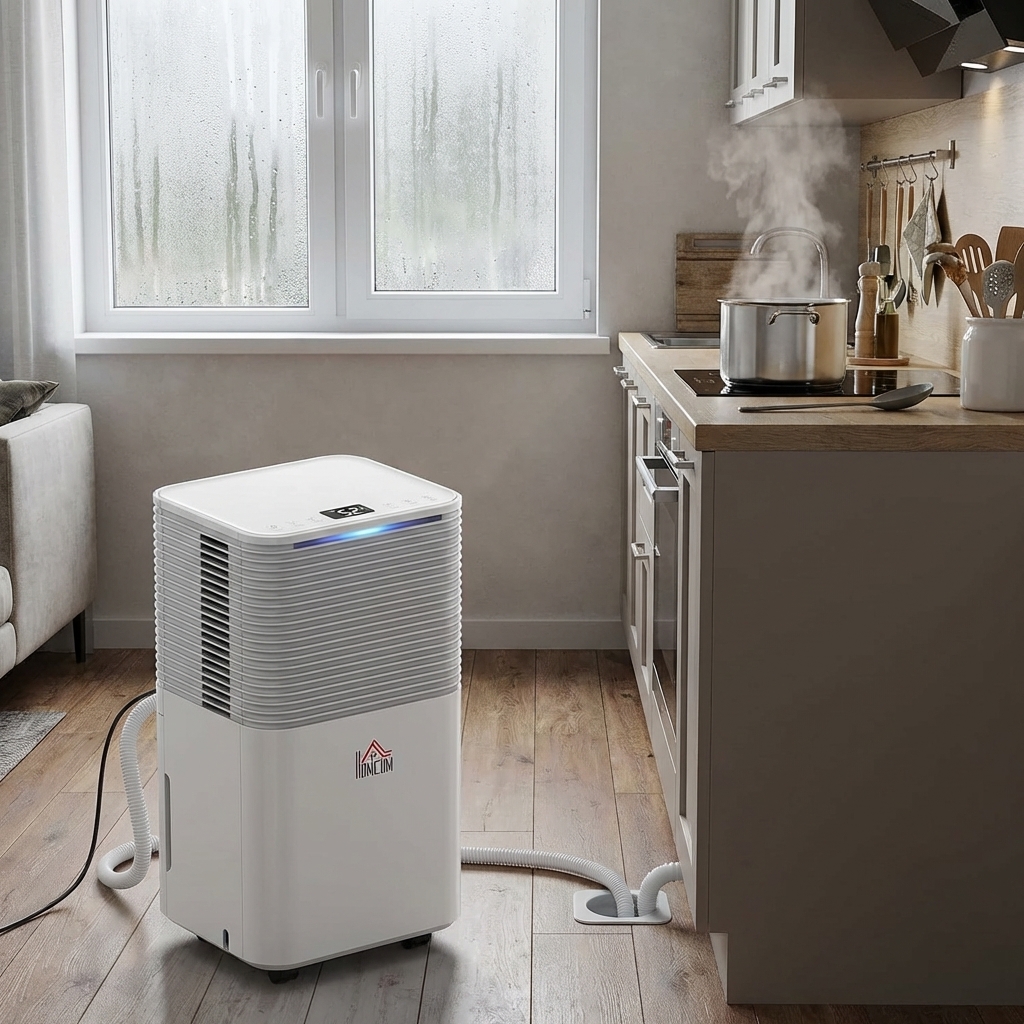
In typical UK homes, the practical value of a HOMCOM dehumidifier is less about chasing an abstract “ideal” humidity number and more about how quickly the unit stops the familiar cycle: windows misting up overnight, a musty edge to soft furnishings, and damp patches that seem to reappear after every cold spell. The 12L/day unit’s sweet spot tends to be steady, repetitive moisture loads—regular showers, cooking steam, and background humidity from a lived-in space—rather than sudden, extreme floods of moisture.
Where it often feels most convincing is consistency. Once the room has been pulled down from “sticky” air into a more stable band, the humidity sensor-driven behaviour becomes the real differentiator: it can throttle effort rather than running flat-out for hours. That matters for noise, heat output, and the subtle annoyance factor of a machine that never seems to stop. In practice, sensor control is only as useful as placement; tucked into a corner or blocked by furniture, readings can lag behind what the room actually feels like at occupant level.
Extraction Claims Versus Room Reality
“12L/day” is best treated as capacity under favourable conditions, not a guarantee that 12 litres will be pulled from an average room every day. Cooler rooms, lower starting humidity, and intermittent door opening all reduce real extraction. The more relevant question is whether the unit can meaningfully change the feel of a problem space within a few hours, and then maintain it without becoming intrusive.
For a mid-sized room with recurring condensation, the 12L/day HOMCOM dehumidifier usually has enough headroom to make progress without needing constant babysitting. In larger, leakier spaces—or rooms that are effectively connected to the rest of a home via open doors and stairwells—the same unit can start to feel like it is “holding the line” rather than decisively improving conditions. That isn’t a flaw so much as a mismatch between expectations and the physics of air exchange.
- Moisture source intensity changes everything: a closed room with predictable moisture behaves very differently from a shared, open-plan area where humidity keeps being replenished.
- Temperature is a quiet limiter: colder air holds less moisture, so extraction slows even when the room still feels clammy.
- Air movement affects speed: if humid air cannot circulate to the intake, the unit may pull down the immediate area while the rest of the room lags behind.
Tank Size, Emptying Rhythm, And the Real Cost of Convenience
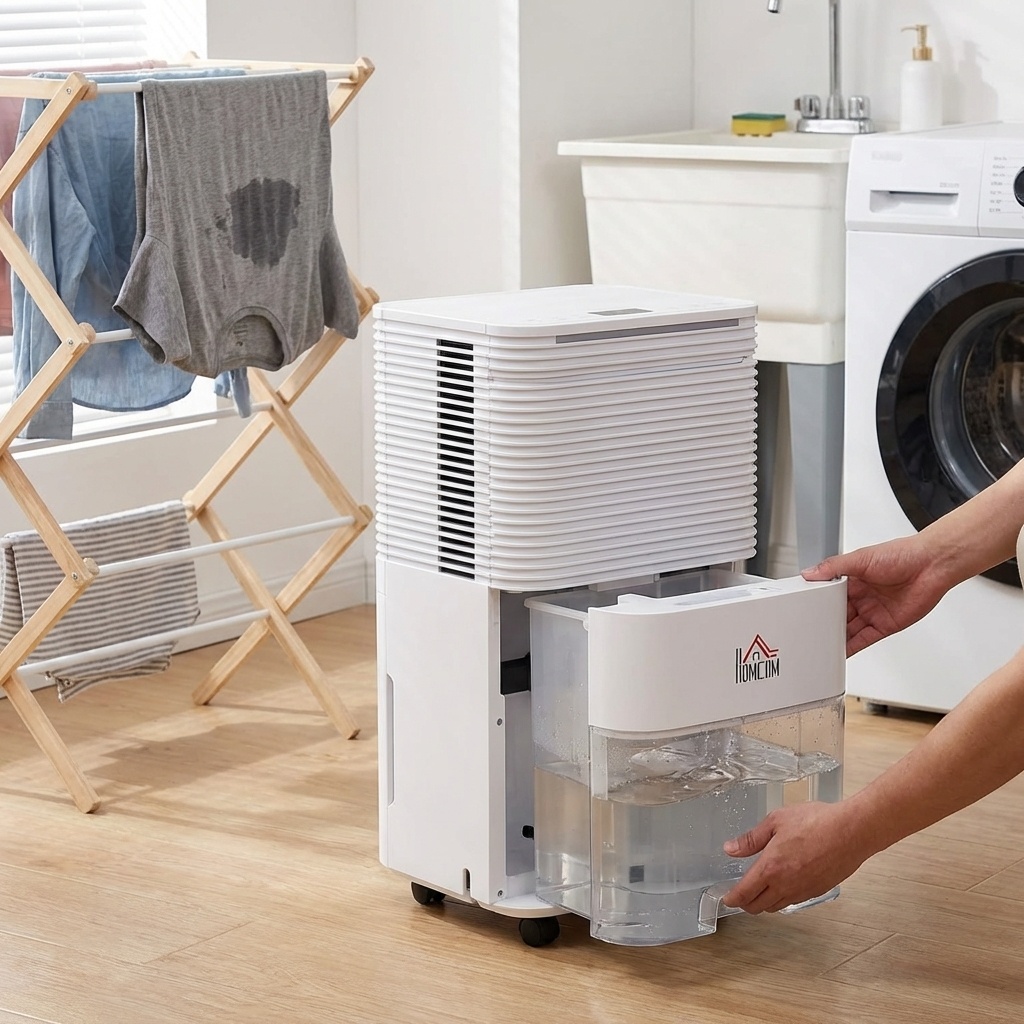
A 2L tank can be perfectly workable, but it sets the “attention schedule” for the owner. In damp weather, or when the unit is tasked with laundry drying, the tank can fill faster than expected, turning a set-and-forget idea into a routine of checking and emptying. That routine is tolerable when the unit is kept somewhere easy to access; it becomes irritating if the best-performing placement is out of the way.
Continuous drainage support (where present on a model) can be a genuine quality-of-life upgrade, but only if there is a sensible drain point and the hose run does not create trip hazards or awkward routing. Without that, the experience is dominated by the tank: capacity, how cleanly it seats back in place, and whether the full-tank stop is predictable rather than surprising.
Laundry Drying: Useful, But Not Magic
The laundry mode framing makes sense for UK living, yet it is also where expectations need the most discipline. A HOMCOM dehumidifier can shorten drying times and reduce that cold, damp smell that comes from moisture lingering in fabric, but it does not replace airflow. If wet clothes are packed tightly on a rack, the unit is forced to work on a slow-release moisture source and the room can still feel stagnant.
In real use, the best outcomes come from treating the unit as one part of a system: reasonable spacing on the rack, a mostly closed door, and enough time for the machine to keep pulling moisture as it evaporates. When those conditions are not met—doors opening constantly, a draughty hallway, or laundry placed in a large room—the benefit becomes more modest and the running time climbs.
Noise, Sleep Use, And Where the Unit Fits Best
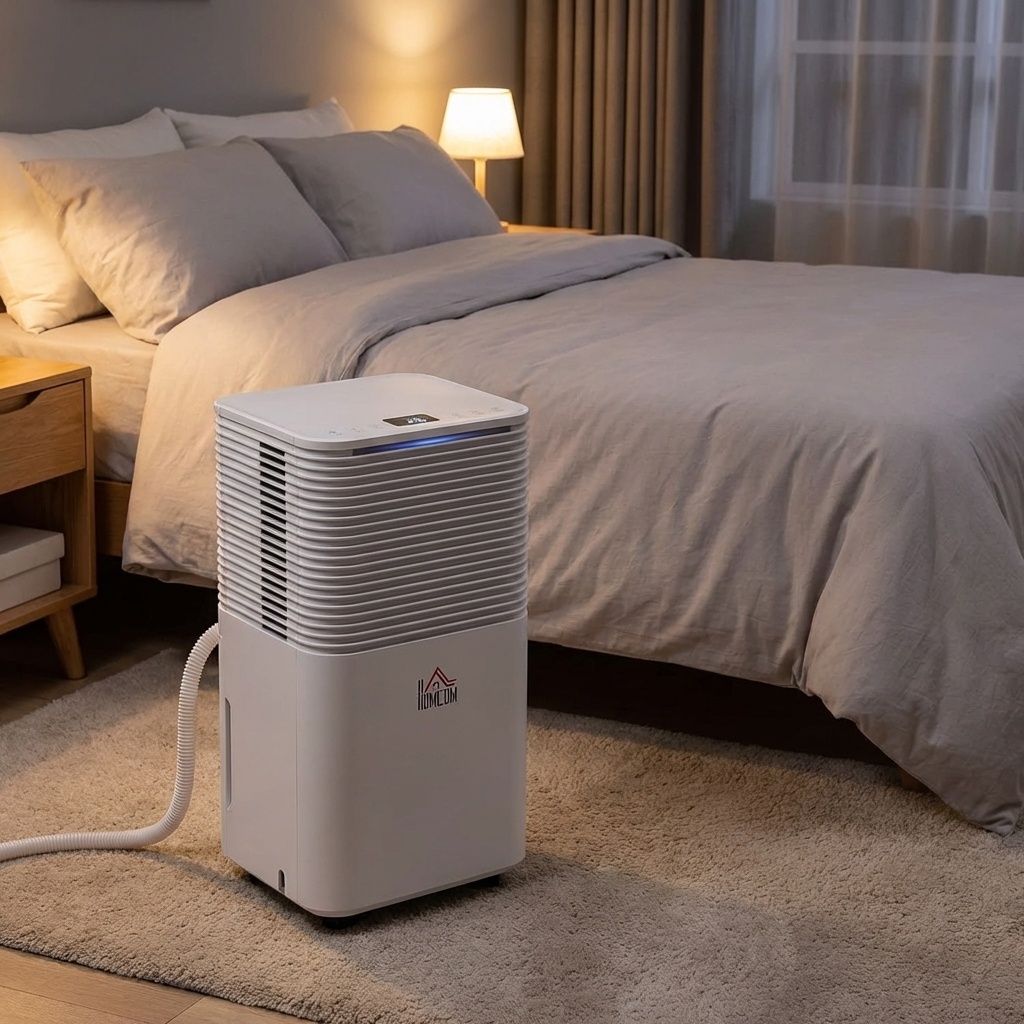
Dehumidifiers are rarely silent; what matters is whether the sound profile is easy to ignore. With units in this class, the fan character tends to be the dominant element, and the perceived loudness changes dramatically with surfaces and room acoustics. Hard floors and bare walls reflect noise; carpets and soft furnishings absorb it. That is why a bedroom placement can feel acceptable in one home and distracting in another, even with the same machine.
Sleep modes are helpful when they reduce both fan speed and display brightness, but the trade-off is slower extraction. In a room that is already under control, the slower pace may be fine. In a room still fighting condensation, a quieter mode can simply delay improvement—leading to a “quiet but unchanged” experience that feels disappointing.
Controls, Timer Use, And How “Smart” Changes the Experience
Basic timers and clear mode switching matter more than they look on paper. A 24-hour timer is not just a convenience feature; it is a way to align operation with occupancy and tolerate noise by running harder while the room is empty. For users who dislike constant background sound, this can be the difference between using a dehumidifier consistently and leaving it off until problems return.
App control, as seen on the HOMCOM Dehumidifier with WiFi Smart App Control, mainly changes the friction of adjustment rather than the underlying extraction ability. It makes sense when the unit is placed somewhere inconvenient—an upstairs landing or a back room—because it reduces the temptation to “set it once and forget it” even when conditions change. The flip side is that smart features add another layer of expectation: connectivity stability, intuitive controls, and notifications that are useful rather than noisy.
Positioning Within the HOMCOM Range: 10L, 12L, And 16L In Practice
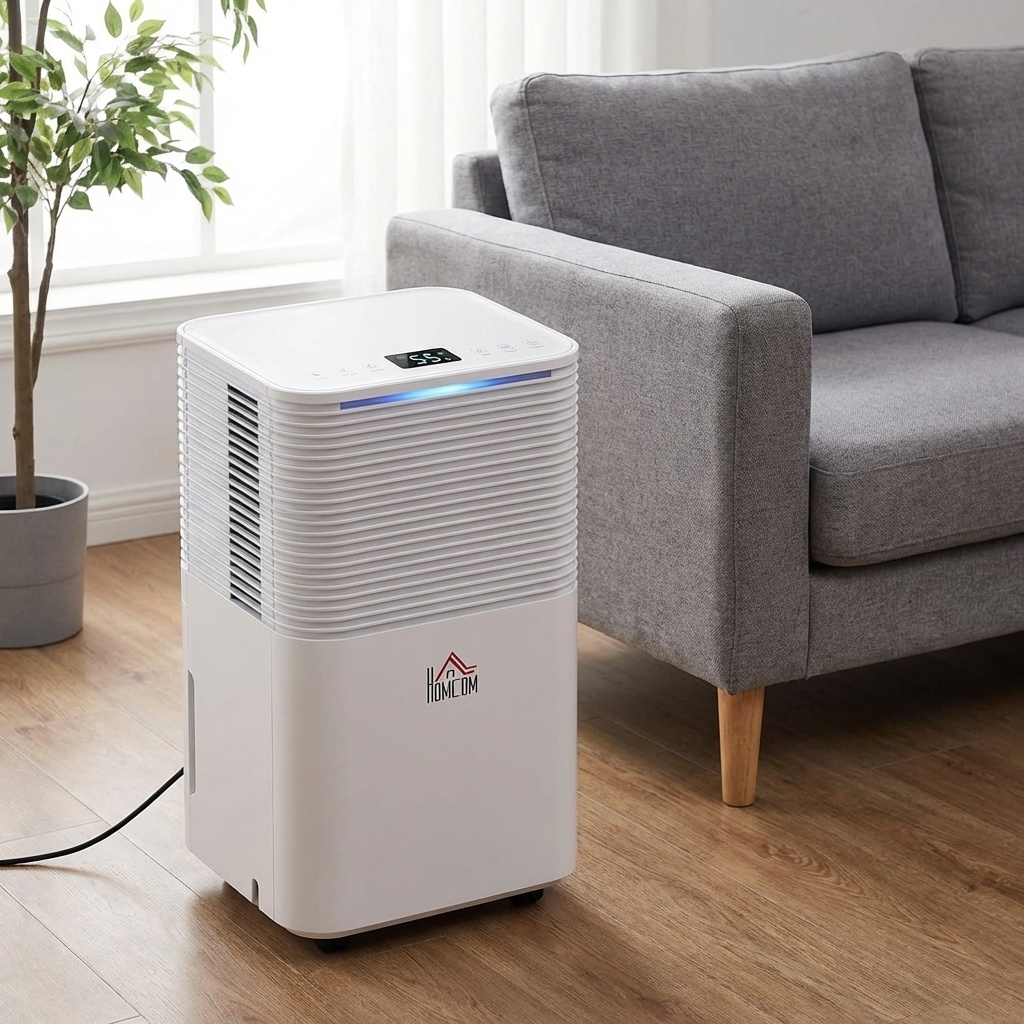
The 12L/day HOMCOM dehumidifier sits in a practical middle ground: typically more capable than entry-level output, without the physical bulk and higher draw that often comes with higher extraction classes. The 10L/day option can make more sense where the damp issue is mild, the room is smaller, or noise sensitivity is high—because a slightly smaller unit run for longer can feel less intrusive than a larger one cycling aggressively. The 16L/day unit starts to look more appropriate when the goal is faster recovery after spikes in humidity, or when the space is persistently challenging.
| Scenario | What Tends To Matter Most | Which HOMCOM Capacity Usually Fits Better |
|---|---|---|
| Small room, intermittent condensation | Steady maintenance, lower perceived intrusion | 10L/day |
| Typical bedroom/office with recurring damp feel | Balanced extraction and manageable attention to emptying | 12L/day |
| Larger room or consistently damp lower level | Faster pull-down, less “always running” feeling | 16L/day |
Nuances And Limitations That Change The Decision
There are a few points that tend to separate satisfied owners from disappointed ones, and most of them are about fit rather than raw capability. A HOMCOM portable dehumidifier can be a strong solution when the problem is airborne moisture and the room can be treated as a zone. It becomes less satisfying when the damp issue is structural—water ingress, persistent cold bridging, or inadequate ventilation—because the unit is then managing symptoms that quickly reassert themselves.
- If the space cannot be reasonably closed off, the unit may feel underpowered even when it is working as designed.
- If emptying a tank is likely to be neglected, a model with continuous drainage support becomes more than a nice-to-have.
- If the goal is “set it in a corner and forget it,” placement and airflow can quietly undermine performance.
- If quiet operation is non-negotiable, the realistic trade-off is slower drying and longer run times.
What A HOMCOM Dehumidifier Manual Usually Tells, And What It Does Not
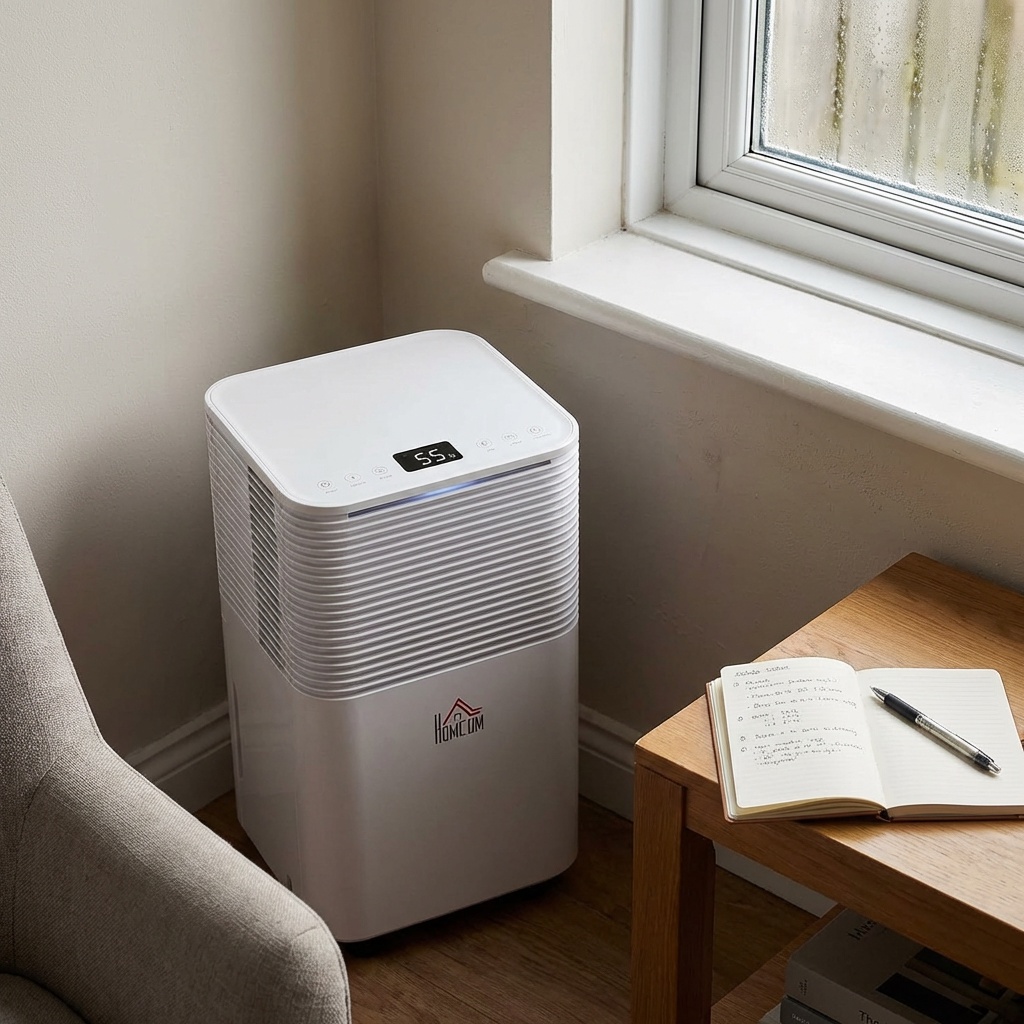
A HOMCOM dehumidifier manual typically covers safe clearances, filter cleaning, basic error states, and drainage setup. The missing layer is often behavioural: how much doors, heating patterns, and occupant habits change outcomes. That gap is why “HOMCOM dehumidifier how to use” searches are so common—people are not confused by buttons, they are trying to reconcile the promise of drier air with a room that still feels damp.
In practical terms, the most meaningful “how to use” insight is rarely a hidden setting; it is treating the unit like a room tool rather than a whole-home fix, aligning the timer with when moisture is generated, and choosing a placement that lets the fan pull from the room rather than from a dead corner. When those basics are in place, the 12L/day model’s sensor-driven behaviour has a better chance of feeling purposeful instead of random.
HOMCOM Dehumidifier As A Choice: What It Does Well And What It Quietly Demands From The Room
A HOMCOM dehumidifier in this capacity range is at its best when the goal is steady, everyday moisture control rather than dramatic “before and after” changes in a single afternoon. In real homes, that distinction matters: it tends to feel most effective when it can run regularly, doors can be managed, and the unit is allowed to work on one zone at a time instead of being expected to “fix” an entire property through open-plan air movement.
The practical upside is that the experience is usually straightforward: set a target, let the humidity sensor do the repetitive work, and accept that extraction is a process shaped by temperature, airflow, and how much moisture is being introduced each day. The trade-off is that expectations need to stay realistic—especially in colder spaces, or where external moisture sources keep replenishing the load faster than the unit can pull it down.
- This type of unit tends to make the most sense where damp feels persistent rather than occasional, and the priority is keeping humidity from creeping up day after day.
- It is less satisfying for “quick rescue” scenarios where the room is cold, air circulation is poor, and the moisture source is continuous (for example, frequent open windows in wet weather).
- It rewards basic discipline: keeping internal doors sensibly positioned, avoiding needless drafts, and giving the machine time to stabilise rather than constantly changing settings.
Where The HOMCOM Dehumidifier Fit Is Strongest (And Where It Can Feel Like The Wrong Tool)
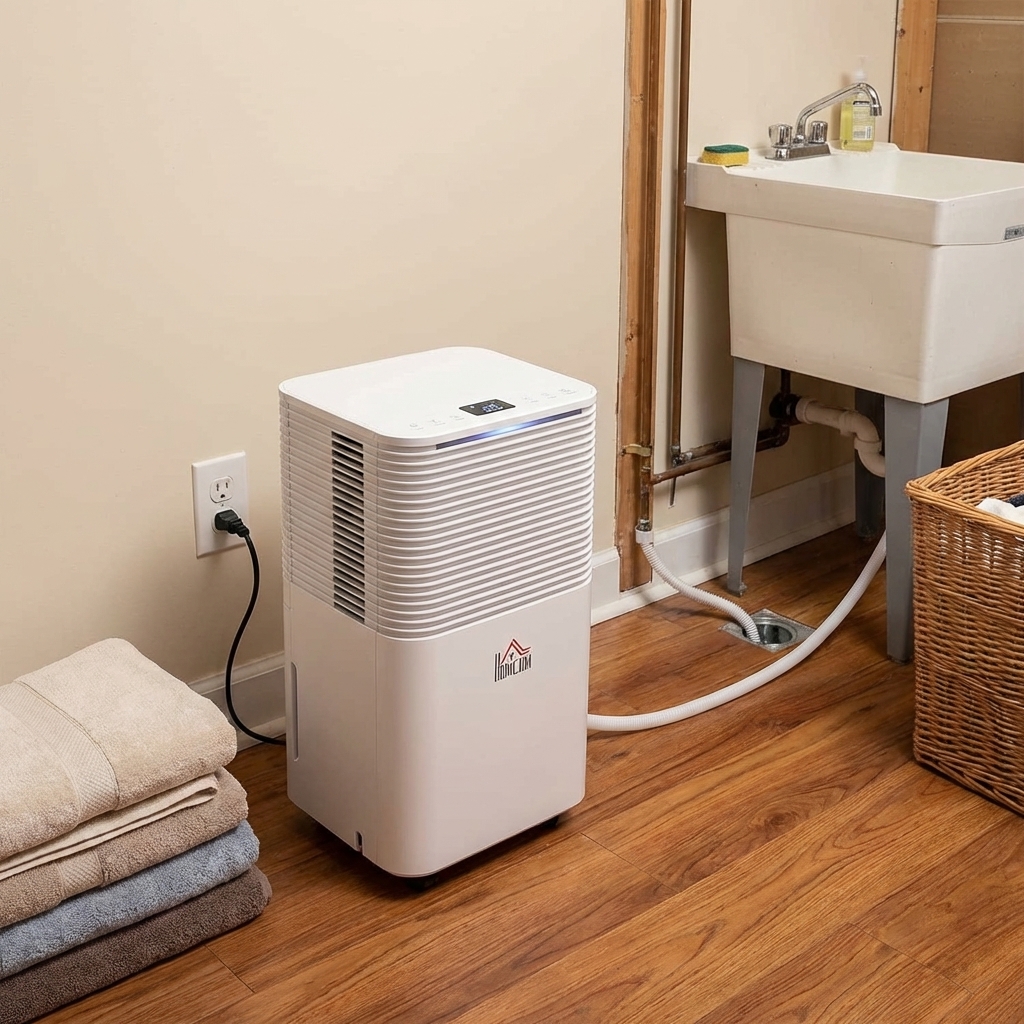
For many buyers, the real question behind a HOMCOM dehumidifier review is not whether it extracts water at all, but whether it fits the way the home is actually used. This is where the decision becomes simple: the match is strong if the unit can be treated as a routine appliance, and weaker if it is expected to behave like a one-time solution.
It is a good fit for households that want measurable control and are happy to let a machine run in the background. It can be a poor fit for anyone who cannot tolerate audible operation in the same space, or who needs a hands-off setup without regular emptying or drainage planning.
- Predictability is the main advantage: once a pattern is established (run times, target humidity, placement), performance becomes consistent rather than surprising.
- Convenience depends on the drainage approach; manual emptying can feel fine for some routines and quickly feel tedious for others.
- Perceived impact is usually strongest when humidity is high enough to begin with; if the home already sits near comfortable levels, the change can be subtle.
Model Positioning Inside The Range: When 10L, 12L, 16L, Or WiFi Actually Changes The Decision
Shopping the range can look like small numbers on paper, but the difference shows up in how often the unit needs attention and how much “headroom” it has on wetter days. A Dehumidifier HOMCOM around 10L per day typically suits lighter, more contained moisture loads. Moving up to 12L is often about reducing the sense that the unit is always running at its limit. The 16L class is more about resilience—more tolerance for higher humidity and fewer compromises when conditions are not ideal.
WiFi control is less about extraction and more about how the unit fits into daily habits. If the schedule is irregular and the aim is to adjust settings remotely or check status without walking to the unit, app control can reduce friction. If the unit is set once and left to run on a stable target, WiFi often becomes a nice-to-have rather than a deciding factor.
- Choose lower capacity if the goal is modest control and the unit will be used in shorter sessions.
- Choose mid capacity if consistency matters and the unit needs to cope with typical “UK damp” swings without feeling stretched.
- Choose higher capacity if the space is persistently humid, larger, or the unit must recover faster after spikes—while still accepting that temperature and airflow can limit results.
Decision Clarity: Who Should Buy This HOMCOM Portable Dehumidifier And Who Should Look Elsewhere
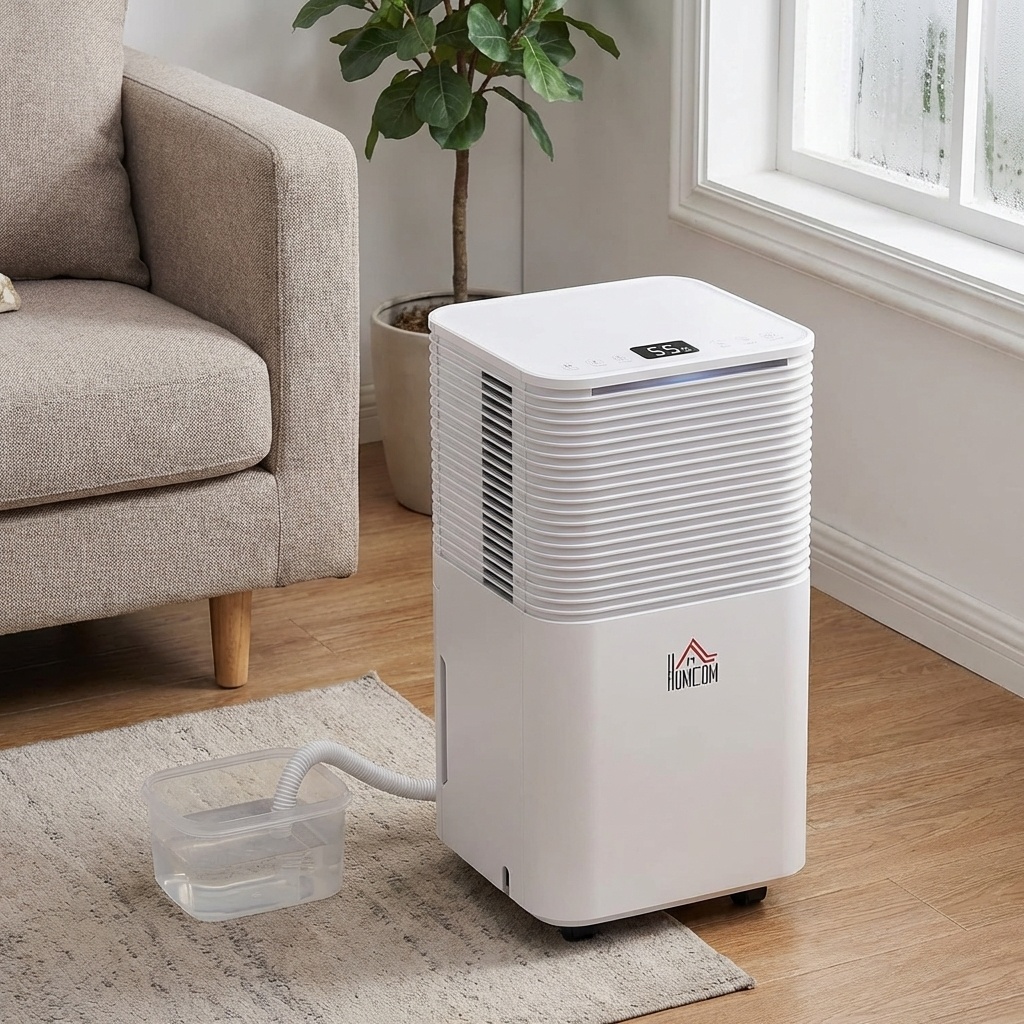
A HOMCOM dehumidifier is for buyers who want a practical appliance that can steadily pull humidity down and keep it there, provided it is used in a controlled way. It suits people who prefer a set-and-monitor approach and can live with the everyday realities: some sound, some heat output, and either tank emptying or a drainage plan. It also suits anyone who values “good enough, consistently” over chasing the maximum possible extraction rate at all times.
It may not suit buyers who need near-silent operation in the same room for long periods, who cannot manage regular water handling, or who expect one unit to solve damp across multiple rooms with doors open. It is also a less comfortable match for very cold spaces where dehumidifiers in general can feel slower and less responsive; in those conditions, the machine can still help, but the timeline stretches and the payoff feels less immediate.
Realistic expectations are simple: the unit can reduce humidity and help limit the conditions that support condensation and mustiness, but it cannot remove the reasons moisture keeps entering the home. If the underlying moisture input stays high, the best outcome is often “managed” rather than “eliminated,” and that is still a meaningful win when the goal is comfort and control.
FAQ: HOMCOM Dehumidifier Review Questions People Actually Ask
Is A HOMCOM Dehumidifier Worth It Compared With Spending More?
It can be worth it when the priority is steady humidity control and the home’s moisture load is within what a mid-capacity unit can realistically handle. Paying more tends to buy comfort features, refinement, or more headroom, not a different underlying reality of how dehumidification behaves in cold or very leaky spaces.
Why Does A Dehumidifier Sometimes Feel Like It Is Doing Nothing?
Usually because conditions are limiting extraction: low temperature, constant drafts, open internal doors, or a moisture source that keeps replenishing humidity. It can also be that the target setting is close to the current humidity, so the machine cycles and the change feels subtle rather than dramatic.
What Should Be Checked First When Looking For A HOMCOM Dehumidifier Manual?
Start by confirming the exact model identification on the unit and matching it to the correct documentation, because similar-looking units can have different controls and indicators. If a manual is missing, the key information to verify is drainage guidance, error indicator meaning, and how the humidity target behaves in each mode.
Does “How To Use” Matter Much, Or Is It Just Plug And Go?
Basic use is simple, but outcomes depend heavily on placement, airflow, and how the space is managed. Small changes—like keeping the unit away from obstructions and treating one zone at a time—often matter more than constantly changing settings.
Is WiFi Control A Real Advantage In A HOMCOM Dehumidifier With Smart App Control?
It is most useful when the unit needs to be adjusted around a changing routine, or when checking status without going to the room reduces friction. If the unit will run to a stable humidity target on a predictable schedule, WiFi tends to be convenience rather than performance.