A HOMCOM air cooler can make sense when heat feels persistent but the room, the budget, or the installation reality does not suit a fixed system. The trade-off is predictable: comfort can improve noticeably in the right conditions, but it is rarely the “shut the door and forget it” experience people expect from heavier-duty cooling.
For this review, the reference point is the HOMCOM Portable Air Conditioner 7000 BTU. It is not being treated as a miracle fix; it is being treated as a practical object that has to live in a real home, with windows that do not always cooperate and noise that is never truly invisible.
Context first, quickly:
-
A “HOMCOM air cooler” search usually mixes two ideas: evaporative cooling units and portable air conditioning units; they behave differently, and expectations often drift.
-
Portable air conditioning is about extracting heat and pushing it out through a window kit; it tends to be more decisive but also more demanding (exhaust, placement, noise, condensate handling).
-
Evaporative cooling is about airflow and moisture; it can feel pleasant in some environments, but it is not a substitute for true heat extraction.
What The Main Unit Is (And What It Is Not)
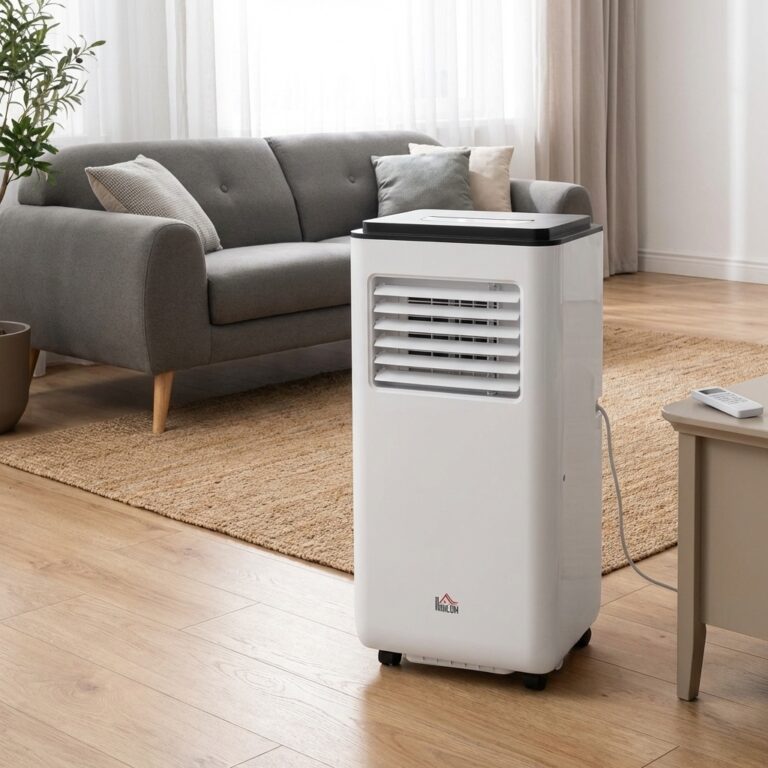
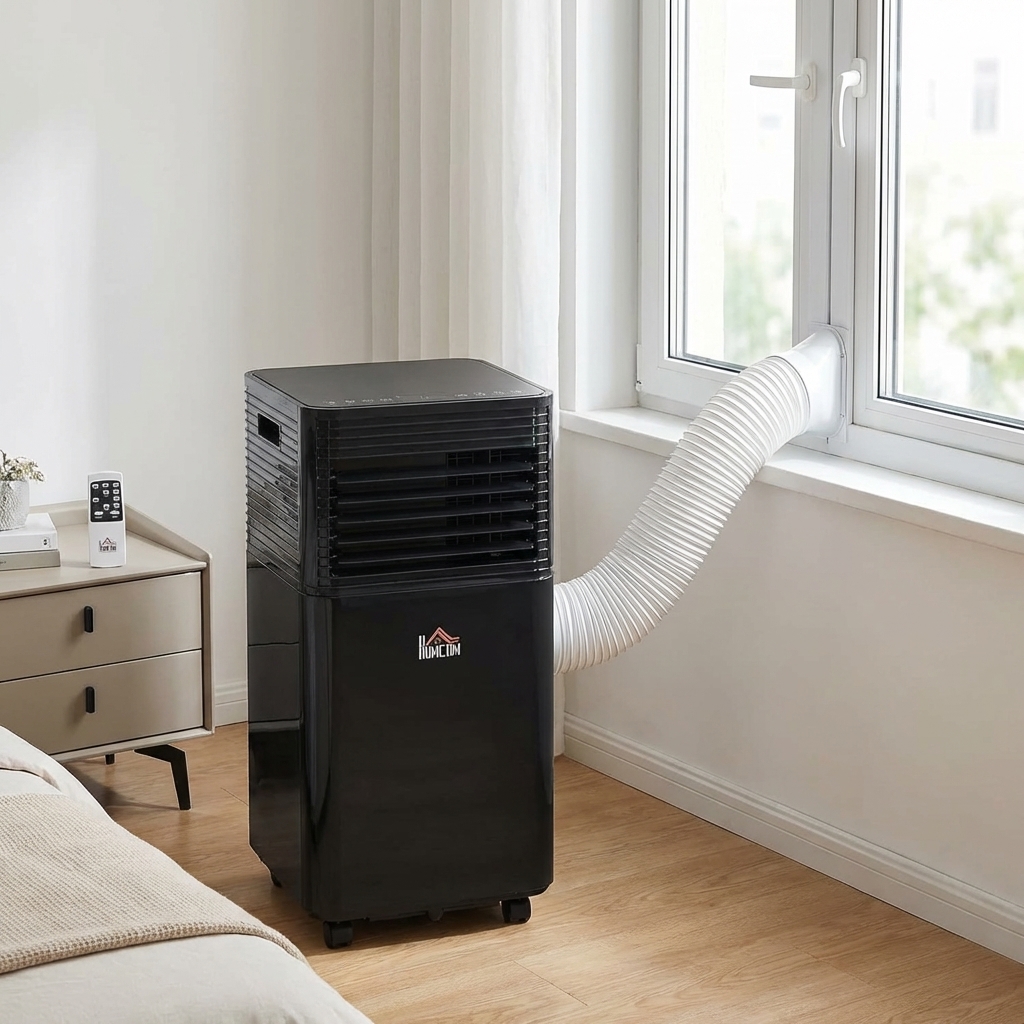
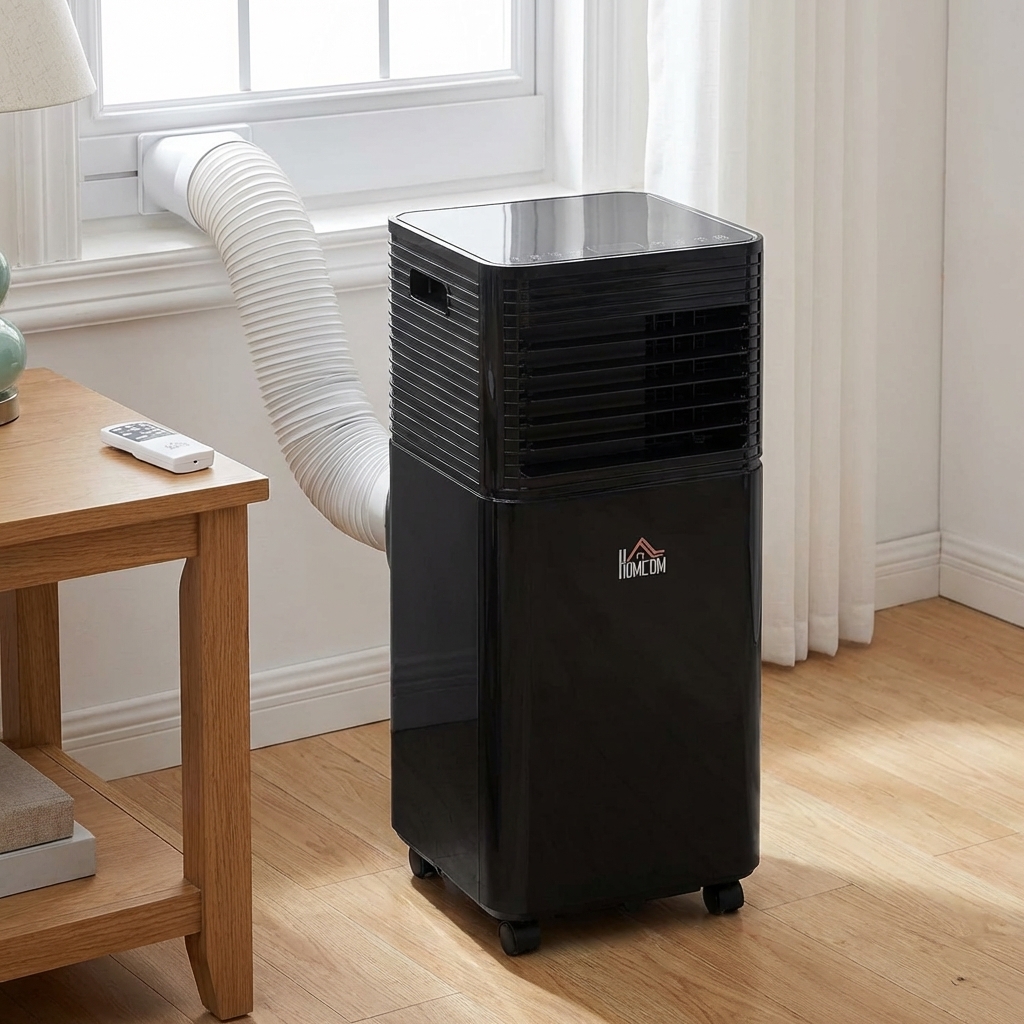
The HOMCOM Portable Air Conditioner 7000 BTU is a wheeled, self-contained unit designed to cool a single space by venting warm air outside. In practical terms, it is closer to a compact appliance than “hidden climate control”: it occupies floor space, it needs a workable window arrangement, and it will be present in the room both visually and acoustically.
It also tries to cover the common use pattern behind the HOMCOM portable air cooler query: cooling when needed, airflow when full cooling is unnecessary, and some humidity management during muggy spells. Those extra modes can be genuinely useful, but they do not remove the core realities of portable air conditioning—heat still has to go somewhere, and that “somewhere” is outside through an exhaust hose.
The most honest way to frame this unit: it is a compromise tool for homes where permanent installation is not on the table. That compromise can be a very good one, provided the room size, window type, and tolerance for operational noise line up.
Early Fit Signal For A Portable Air Conditioner From HOMCOM
This is where the HOMCOM Portable Air Conditioner 7000 BTU tends to fit best—and where it starts to feel less satisfying.
-
Good fit for smaller rooms that overheat in the afternoon or early evening, where closing the door is realistic and the goal is to take the edge off rather than create refrigerated air.
-
Often less satisfying in open-plan spaces, rooms with strong sun exposure and poor shading, or layouts where the unit must sit far from the window and the hose run becomes awkward.
-
Works better for users who can accept “appliance presence”: a visible unit, a hose at the window, and a steady background sound profile.
-
Can feel limiting for very light sleepers or people expecting near-silent operation, especially if the unit must run hard to keep up with heat gain.
Why The Window Setup Matters More Than Most Specs
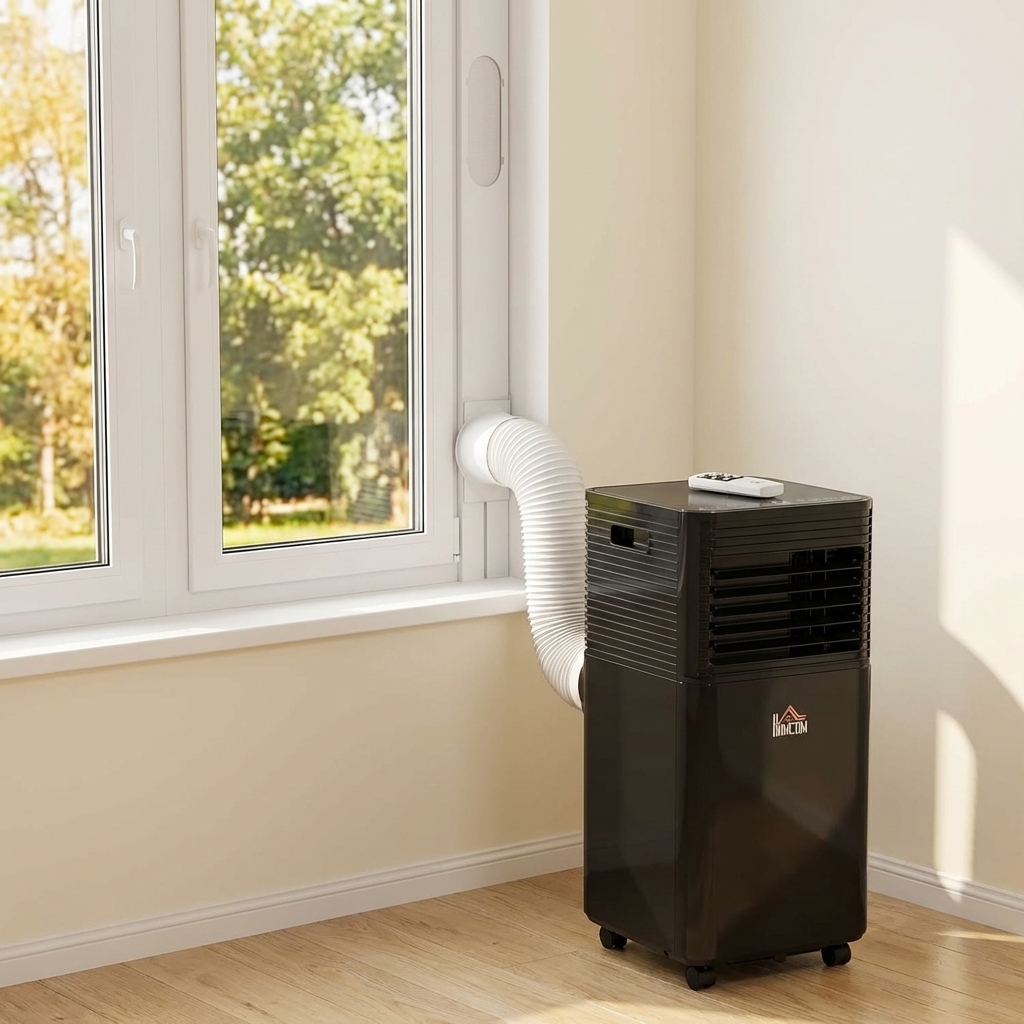
Portable cooling performance is not only about the number printed on the box. The window kit and how cleanly it seals are what decide whether the unit is removing heat efficiently or quietly fighting a losing battle as warm air leaks back in.
In real homes, the weak points are predictable: older frames, unusual window openings, and gaps created by imperfect fit. When the seal is poor, the unit may still cool—just with longer run times, more audible effort, and a room that never quite settles. For anyone approaching this as a “Portable Air Conditioner HOMCOM” purchase, the window reality should be treated as part of the product, not an afterthought.
The 7000 BTU unit is supplied with a window mount kit, which is the right starting point. The practical question is not whether a kit is included; it is whether it adapts cleanly to the particular window style and whether the unit can be positioned so the hose stays short and uncrushed.
What To Expect From The “4-In-1” Positioning
Cooling mode is the headline, but the extra modes are not automatically fluff. A fan-only mode can be useful when the room is warm but not oppressive, and it can reduce the temptation to run full cooling when it is not needed. Dehumidification can matter in sticky weather, where comfort is driven as much by moisture as by temperature.
Still, it helps to keep expectations tight. A portable air conditioner does dehumidify as part of the cooling process anyway; a dedicated dehumidifier mode is mainly about prioritising moisture reduction when temperature is less of the issue. It can feel like a relief in humid spells, but it is not a guarantee of a “dry” room if doors are opening frequently or the space is inherently damp.
Sleep mode is similar: it can be useful for easing the experience at night, but it does not rewrite physics. If the room is still gaining heat and the unit must work, it will still sound like a unit working.
Where This HOMCOM Air Conditioner Sits In The Range
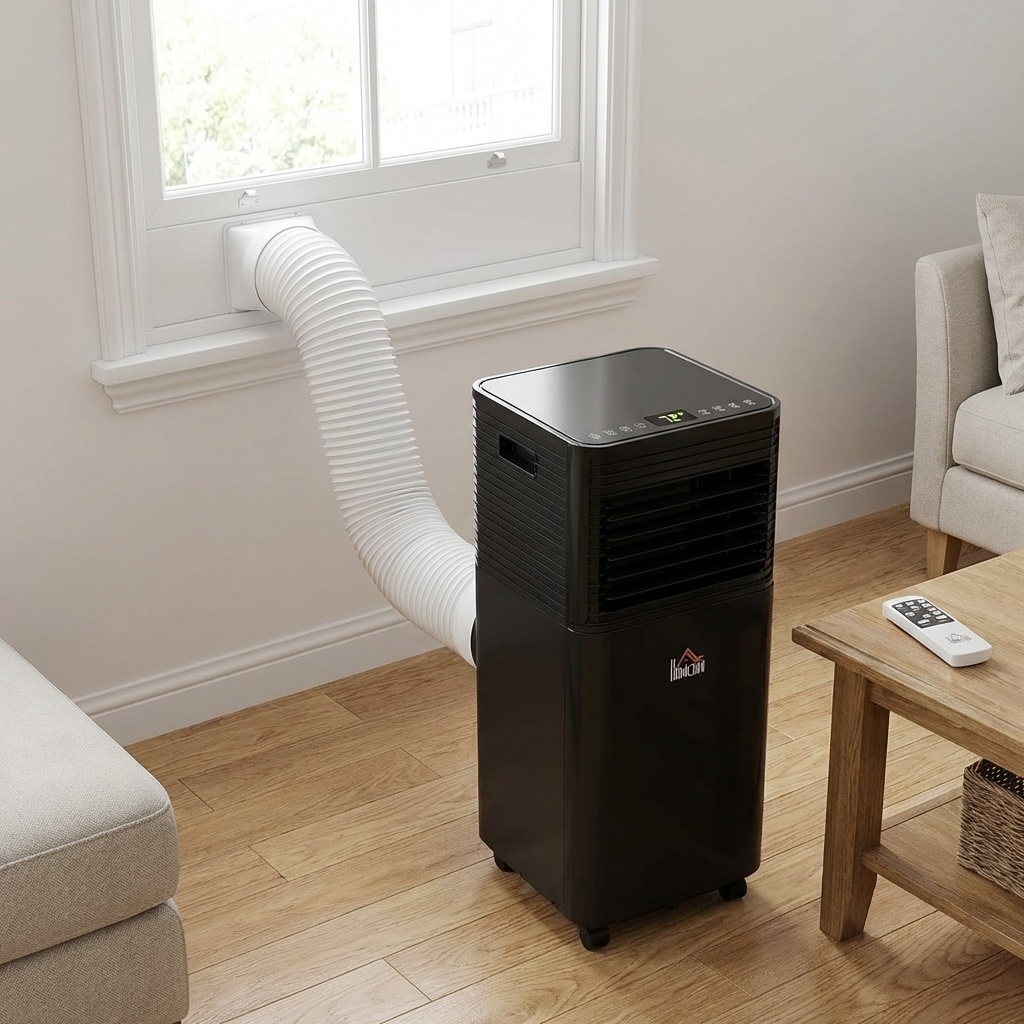
A HOMCOM air cooler search often lands on more than one capacity level. The 7000 BTU model is the more conservative option—more likely to suit modest room sizes and more likely to be chosen for cost and manageability rather than maximum pull-down power. In the same family, the HOMCOM Portable Air Conditioner 10000 BTU exists as a step up in capacity for situations where the smaller unit would be running near its limit too often.
There is also a different path entirely: the HOMCOM Air Cooler, which is not a portable air conditioner in the heat-extraction sense; it is a separate approach that can feel pleasant in some environments but will not behave like an exhaust-vented unit when the air is already humid or the heat load is high.
Linking The Review To Real-World Buying Decisions
The unit being assessed here is the HOMCOM Portable Air Conditioner 7000 BTU. It is worth attention when the goal is contained, room-by-room relief and the window setup is straightforward enough to seal decently.
For shoppers trying to decide between a smaller portable unit and something with more headroom, the HOMCOM Portable Air Conditioner 10000 BTU is the natural comparison point on capacity alone, even before comfort details enter the picture.
And for those using “HOMCOM portable air cooler” to mean an evaporative-style device rather than a vented portable air conditioner, the HOMCOM Air Cooler represents that alternative route—different feel, different constraints, different expectations.
From here, the review needs to do what listings rarely do: translate the spec sheet into lived experience—cooling momentum, noise character, placement compromises, and the situations where a HOMCOM air cooler purchase ends up feeling sensible versus slightly optimistic.
Cooling Feel And Airflow In Real Rooms
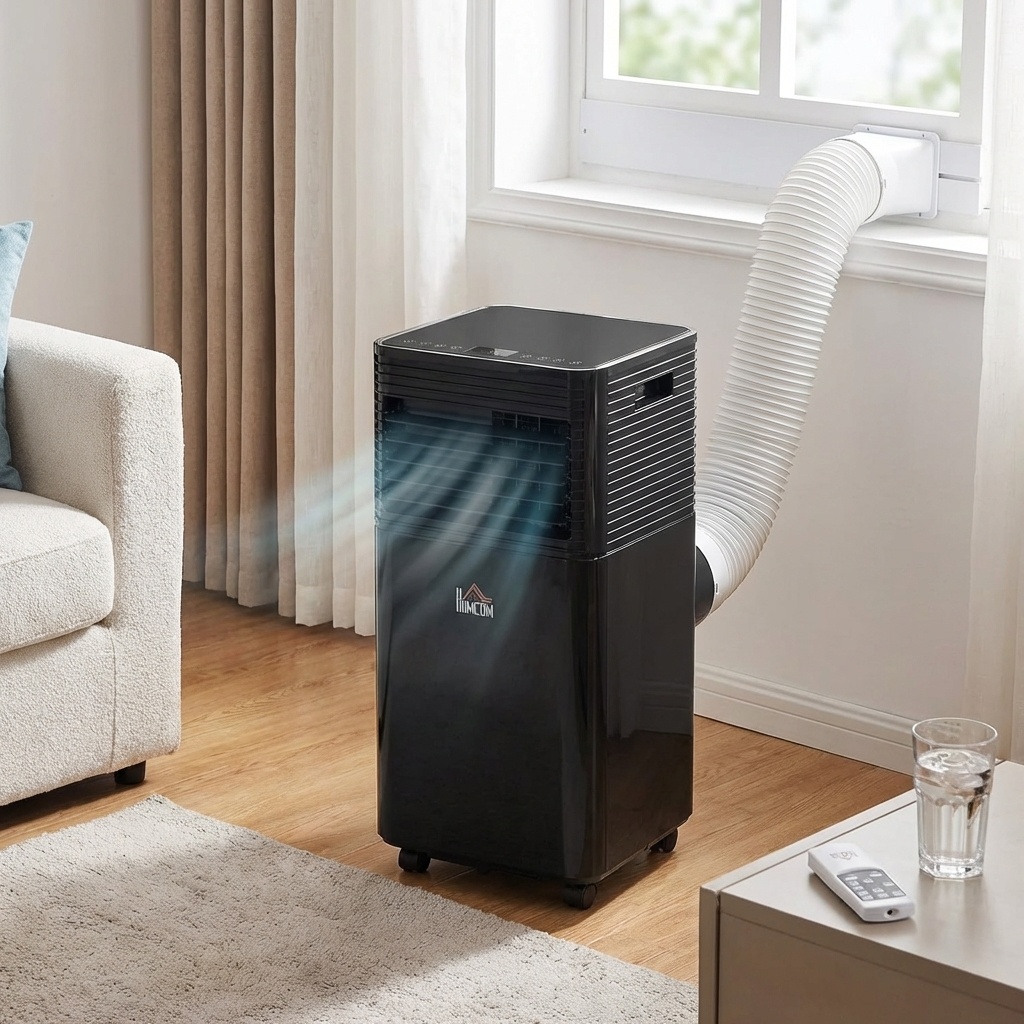
As a HOMCOM air cooler choice, the practical question is how quickly it changes the room experience rather than how cold it can get on paper. With a portable air conditioner, the “win” is usually felt first as a drop in stickiness and a more stable indoor feel, especially once the exhaust is set up properly and the unit isn’t fighting warm air leaking back in.
Airflow direction matters more than many expect. If the discharge is aimed straight across the room, the space can feel cooler faster, but comfort can become uneven: one seat gets blasted while the rest of the room lags. Angling airflow to bounce off a wall or across an open doorway often produces a more even result, even if the first few minutes feel less dramatic.
There is also a reality check built into any HOMCOM air cooler in this format: cooling is local and conditional. Open-plan layouts, sun-facing glazing, and rooms with frequent door traffic can make the unit feel “busy” without ever delivering that crisp, settled temperature people associate with fixed systems. In those situations, expectations need to shift from “whole-home cooling” to “making one zone livable.”
Why Setup Quality Decides Most Of The Outcome
The difference between an impressive and a disappointing experience is often the window interface. Portable units are sensitive to backflow: if warm outdoor air can seep in around the panel, the machine ends up dehumidifying and cooling air that is immediately being replaced.
Common setup details that change performance disproportionately:
- Keeping the exhaust path short and as straight as possible; tight bends and long runs tend to reduce effective heat removal.
- Reducing leakage around the window kit with careful fitting; small gaps can matter because they create a constant warm-air feed.
- Placing the unit with enough clearance so it can breathe; crowding it into a corner can raise intake temperature and reduce efficiency.
This is where the HOMCOM air cooler framing can mislead some buyers: it is not a “place it anywhere” appliance if the goal is meaningful cooling. It behaves more like a system that needs a decent boundary to work against.
Noise And Night Use: What “Sleep Mode” Usually Means In Practice
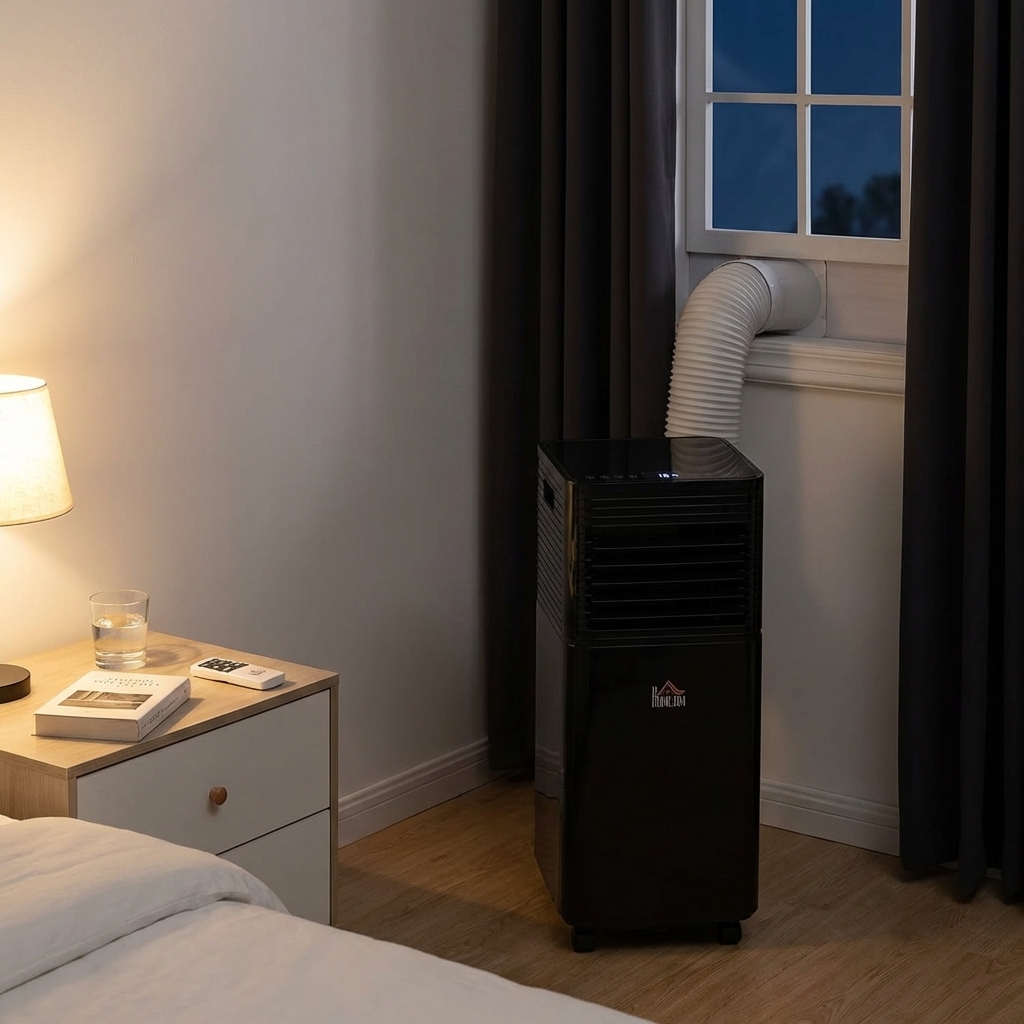
Portable air conditioning is rarely silent, and that reality shapes who will tolerate it. Fan noise is one layer; compressor cycling is another. In a quiet bedroom, the character of the sound matters as much as the volume: a steady whoosh can fade into the background, while frequent on-off cycling draws attention.
Sleep-oriented settings typically aim for a softer airflow profile and less aggressive cycling, but the trade-off is slower pull-down. For someone trying to cool a space quickly before bed, that can feel limiting unless the unit runs earlier in the evening. For light sleepers, it can still be acceptable if the unit is positioned to avoid direct airflow onto the bed and if the room is not being asked to drop several degrees rapidly.
As a HOMCOM air cooler option for night use, it tends to suit households that value a steadier, less clammy feel more than a dramatic temperature drop. If the priority is near-silence, expectations should be cautious.
Dehumidification: The Underappreciated Comfort Lever
In humid weather, the most noticeable improvement may come from drying the air rather than chasing a low temperature number. When moisture is pulled out, sweat evaporates more effectively and the room feels less oppressive. That is often why a portable air conditioner can feel “effective” even when the thermometer barely moves.
The limitation is that dehumidification performance is tied to drainage handling. If the unit relies on a tank that fills quickly, the benefit becomes intermittent because the process stops when the tank is full. Continuous drainage can make the comfort change more consistent, but it requires a practical route for the hose and a willingness to live with the setup.
This matters when comparing “HOMCOM air cooler” expectations to a simple fan-based cooler: a fan can move air and create perceived relief, but it does not reliably reduce indoor moisture. For muggy climates and top-floor rooms that trap humidity, moisture control is often the difference between “tolerable” and “still uncomfortable.”
Positioning Within The HOMCOM Range: 7000 Vs 10000 BTU
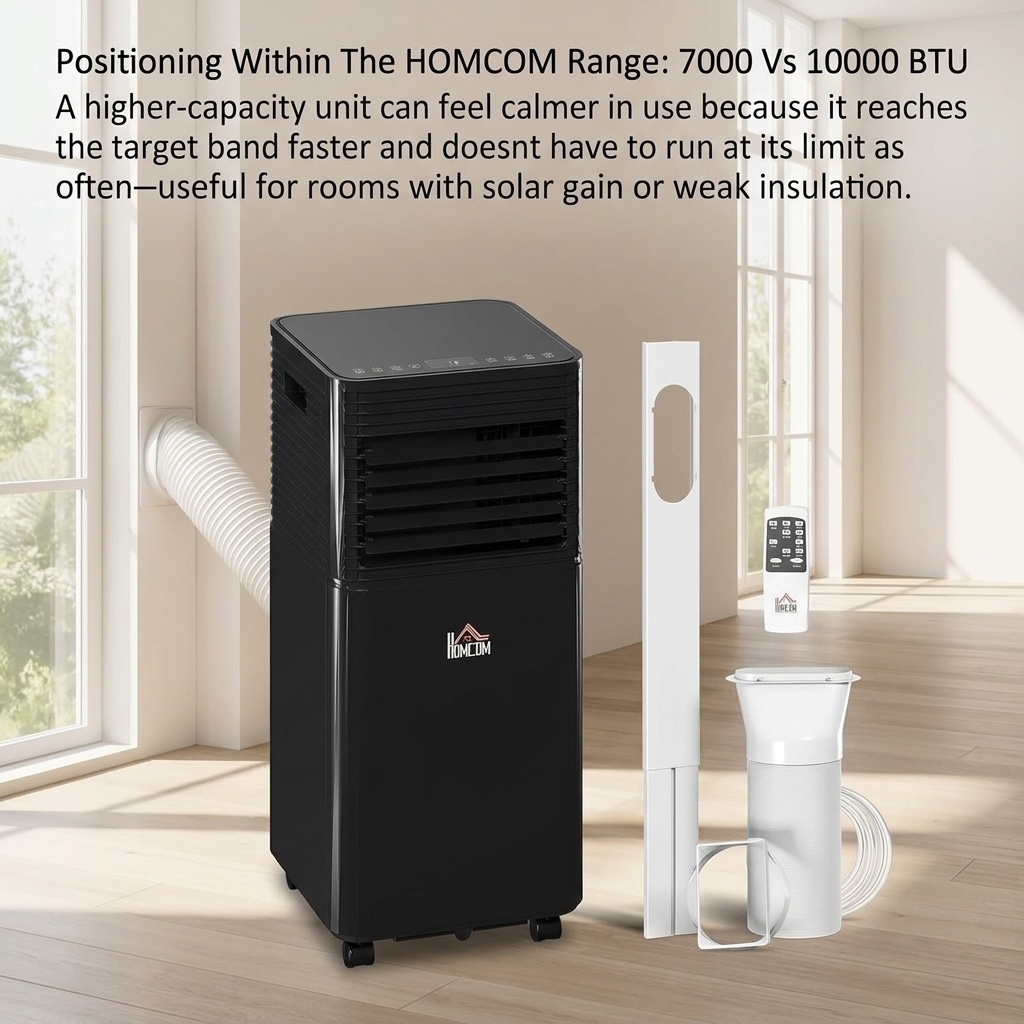
Within this brand’s portable air conditioner lineup, the key difference between the smaller and larger units is less about feature lists and more about how much headroom exists when conditions are unfavourable. A higher-capacity unit can feel calmer in use because it reaches the target band faster and doesn’t have to run at its limit as often—useful for rooms with solar gain or weak insulation.
The smaller-capacity model can still make sense when the room is truly modest in size and can be reasonably sealed. In that context, oversizing can sometimes create a different annoyance: more noticeable cycling and a stronger airflow presence than the room needs.
| Room And Usage Context | How The 7000 BTU Tends To Fit | How The 10000 BTU Tends To Fit |
|---|---|---|
| Compact room with good sealing | Often adequate if expectations are realistic and the exhaust setup is tidy. | Can feel faster, but may be more “present” in sound and airflow than necessary. |
| Warm room with sun exposure or weak insulation | More likely to feel stretched, especially during peak heat. | Typically offers more buffer, holding comfort more steadily under load. |
| Users sensitive to cycling and temperature swings | May cycle more when pushed; comfort can feel less even. | Often runs with more headroom, which can smooth out the experience. |
| People prioritising minimal footprint and simpler handling | Usually the easier compromise on space and day-to-day positioning. | Can be worth it, but the physical presence tends to be less subtle. |
For readers using “HOMCOM portable air cooler” as shorthand for “a portable unit that makes summer manageable,” capacity is the axis that most changes the lived experience. The larger unit is not automatically better; it simply fails less readily when the room fights back.
Where A Fan-Based Cooler Fits (And Where It Does Not)
The HOMCOM air cooler conversation often mixes two different product types: true portable air conditioners and evaporative air coolers. A fan-based cooler can be a reasonable comfort tool when the air is dry and the goal is perceived cooling via airflow and evaporation. In humid conditions, it can feel like it is adding moisture to a room that already struggles to feel comfortable.
It also changes the practical constraints. A fan-based cooler avoids window exhaust, which can be a decisive advantage in rentals or awkward windows. But the ceiling on performance is lower, and the relief tends to be more personal-zone than room-wide. For people choosing between these approaches, the deciding factor is usually humidity and tolerance for installation, not brand loyalty.
Everyday Ergonomics: Controls, Remote Use, And Placement Friction
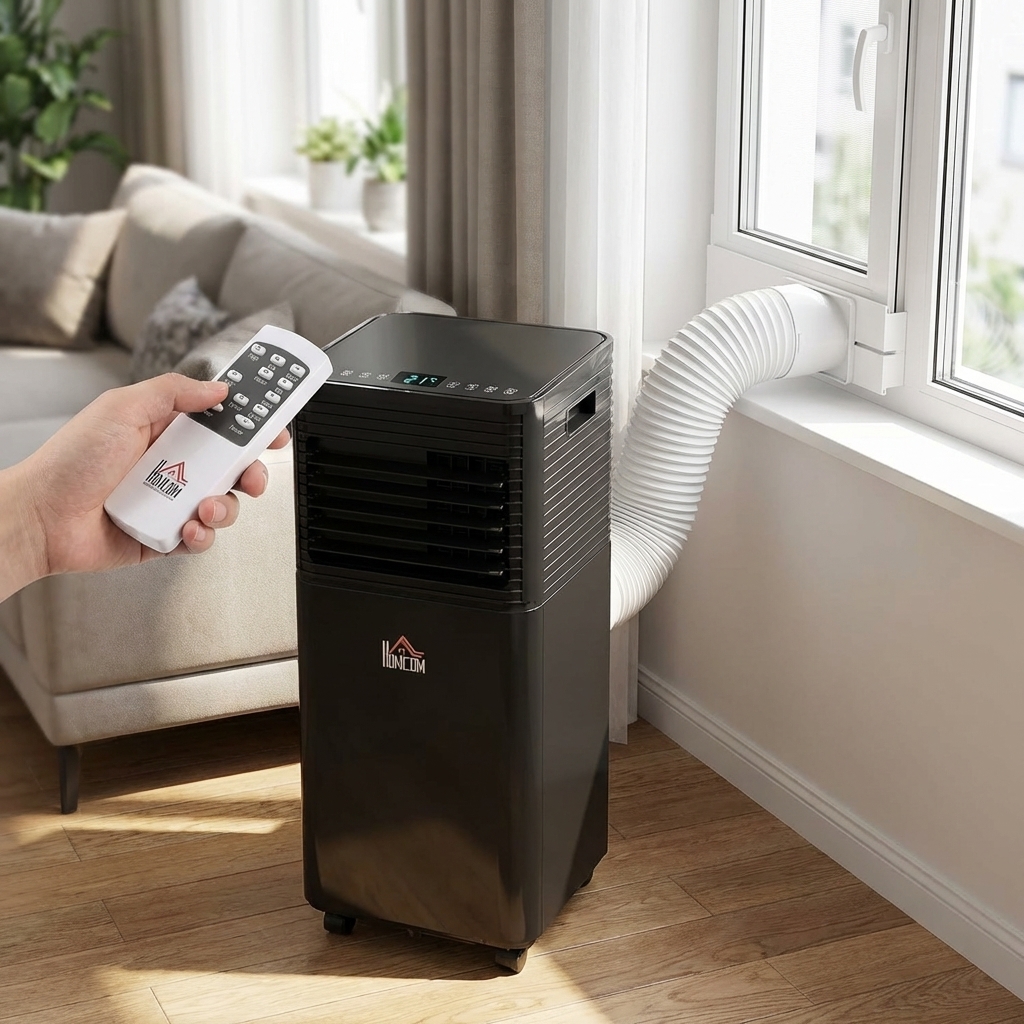
With portable climate units, small convenience details decide whether the product gets used consistently. Remote control helps when the unit is placed for best airflow rather than best accessibility. A clear display is useful, but it does not guarantee better comfort; what matters is whether adjusting settings is intuitive enough that users actually do it instead of leaving the unit on one mode all week.
Timer functions tend to be most valuable when used to pre-condition a room. Running a portable air conditioner earlier, before heat has soaked into walls and furnishings, often feels more efficient than trying to “win” against a fully heat-loaded room at the hottest point of the day. This is one of the more realistic ways a HOMCOM air cooler setup can feel smarter without needing higher capacity.
Placement friction is the quiet downside: moving the unit, managing the exhaust, and keeping the window kit seated can become a low-level annoyance. If the room layout forces the unit far from the window, or if the window type makes a secure seal difficult, the product can be technically capable but practically underused.
Situations Where It May Be Less Suitable
This category works best when the room can be treated like a bounded space. When that assumption fails, the experience changes. The following contexts tend to expose the limits faster than the spec sheet suggests:
- Large open-plan areas where cool air disperses immediately and the unit cannot establish a stable comfort zone.
- Very noisy environments or very quiet sleepers, where the sound profile becomes the primary issue rather than cooling ability.
- Homes with complicated window geometry, where sealing and exhaust routing remain imperfect even with effort.
- High-humidity days where a non-AC “air cooler” approach can feel underpowered or even counterproductive.
In those cases, the decision is less about whether a HOMCOM air cooler is “good” and more about whether the constraints match what portable solutions can realistically do without becoming a daily compromise.
HOMCOM Air Cooler As A Decision: What It Fits, And What It Doesn’t
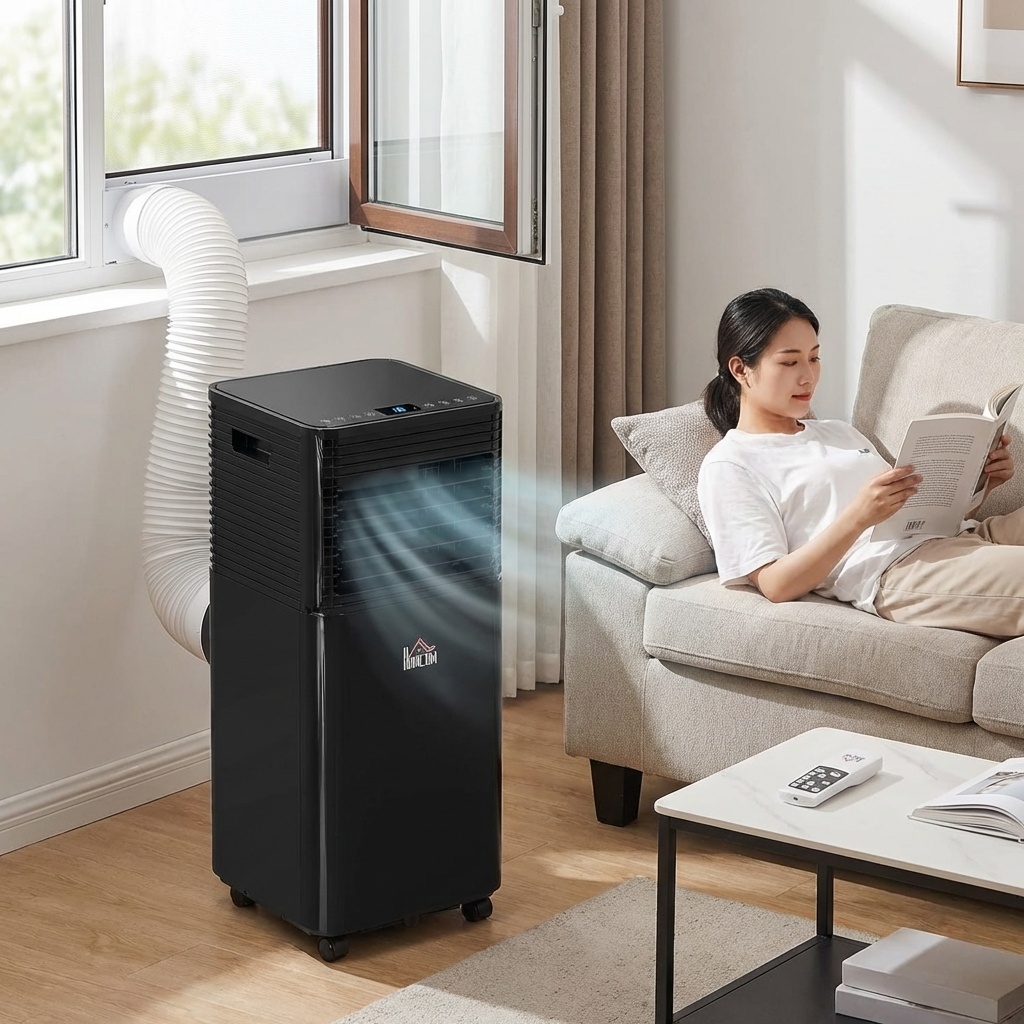
For most people searching “HOMCOM air cooler”, the real decision is less about brand and more about expectations: quick, targeted comfort in a specific room versus whole-home climate control. In that context, a portable unit like the HOMCOM Portable Air Conditioner 7000 BTU tends to make sense when the priority is a noticeable drop in perceived heat in a defined space, without committing to permanent installation. It is a pragmatic choice, not a lifestyle upgrade.
Where this type of HOMCOM air cooler setup tends to feel satisfying is when the room size and the way the room is used match the unit’s strengths. If the space is modest, doors can stay closed for long stretches, and the hottest hours are predictable, the experience is usually straightforward: set a target, let it run, and accept a steady background presence.
It feels less convincing when the situation is fundamentally open-plan, heat gain is extreme, or the goal is “silent, invisible cooling.” Those are not moral failures of the product; they are mismatched requirements. The more the environment fights the unit—sun-baked glazing, constant in-and-out traffic, poor vent routing—the more the user ends up chasing settings rather than enjoying comfort.
Decision clarity can be simplified with a few grounded checks:
- Space discipline matters: the more a room can be treated as a zone (door closed, consistent use), the more a HOMCOM air cooler style portable solution feels effective rather than symbolic.
- Heat sources change the story: heavy cooking nearby, multiple PCs, or strong afternoon sun can push the unit into “always working” territory, which can feel underwhelming even if it is technically operating normally.
- Noise tolerance is personal: some people adapt quickly, others never do—especially for light sleepers or anyone taking calls in the same room.
- Window and vent practicality is the hidden make-or-break factor: if the exhaust routing is awkward, the daily friction rises, and satisfaction drops fast.
When A HOMCOM Portable Air Cooler Makes More Sense Than The Alternatives
A “HOMCOM portable air cooler” choice is often a compromise between immediacy, flexibility, and the realities of a rented or changeable living setup. Compared with permanent systems, the advantage is obvious: it can be moved, it does not require structural work, and it can be used only when needed. The trade-off is equally obvious: it is a more present machine in the room, and its effectiveness depends heavily on how well the space can be managed.
It is typically a stronger fit in these situations:
- Short, intense hot spells where a rapid comfort boost matters more than ultra-low running noise.
- Households that need cooling in one main room during the day and a different room at night, and accept moving the unit as part of the routine.
- Flats and rentals where permanent installation is not possible, or simply not worth the disruption.
- Homes where dehumidification is as valuable as temperature reduction, because sticky air is the main complaint.
It is usually a weaker fit when the expectation is “set it and forget it” across a large footprint, or when the environment demands cooling with minimal acoustic presence. In those cases, the user experience tends to feel like constant negotiation: managing doors, tweaking fan speeds, and trying to keep the room from reloading with heat.
Positioning The Range: Why Some People Step Up From A Basic HOMCOM Air Conditioner
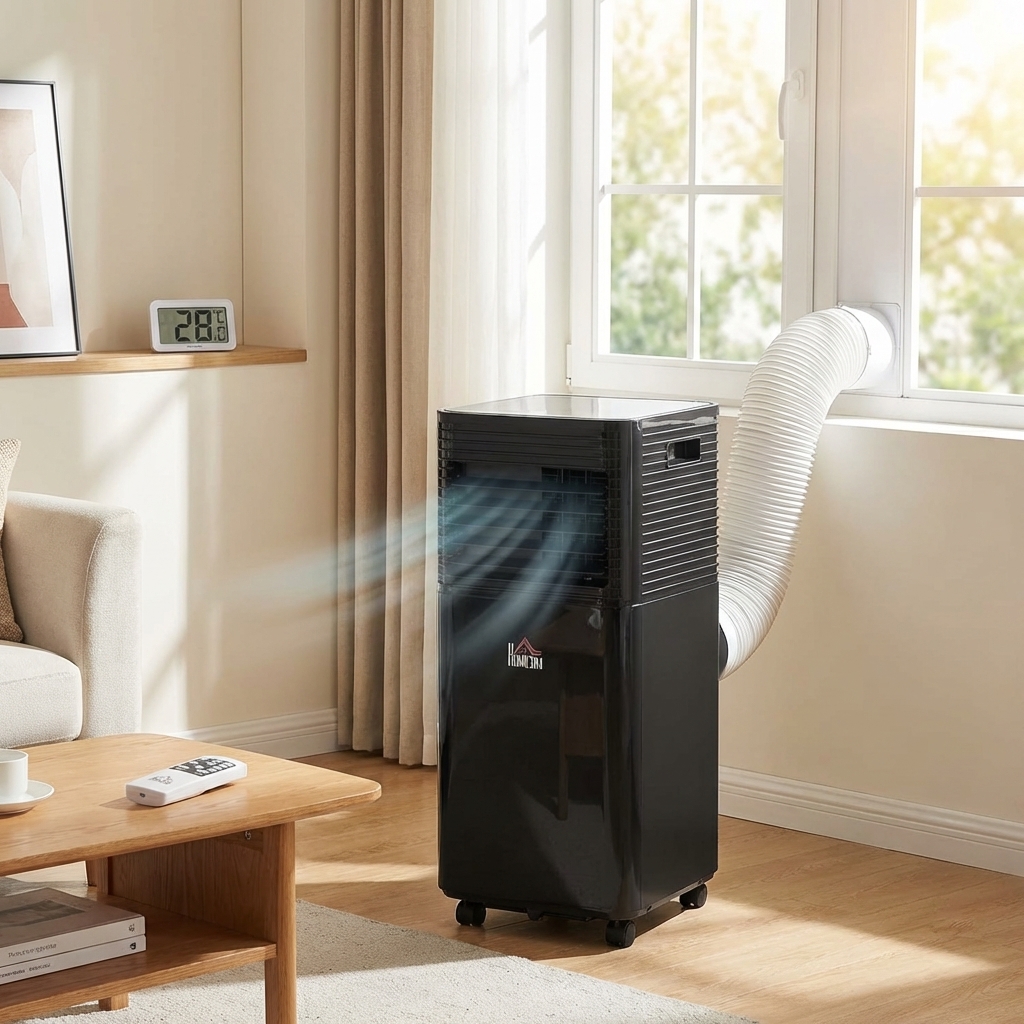
Within the same brand family, capacity steps exist for a reason: not to create a luxury tier, but to address rooms that are harder to cool. If the 7000 BTU class is a good match, it can feel efficient and sensible; if the room is slightly too large or has high heat gain, the same unit can feel like it is always nearly there.
That is where a higher-capacity option such as the HOMCOM Portable Air Conditioner 10000 BTU becomes relevant—not as a guaranteed fix for every problem, but as a way to reduce the “always running, never quite satisfied” pattern in tougher rooms. The decision is less about chasing numbers and more about reducing the practical compromises: less time waiting for comfort, fewer situations where the unit needs to be pushed to its loudest settings, and a bit more resilience during peak heat.
It is also worth separating an air cooler from an air conditioner in everyday terms. A unit like the HOMCOM Air Cooler can be appealing when the aim is airflow and perceived freshness, particularly with moderate heat and tolerable humidity. In truly hot, humid conditions, evaporative-style cooling can feel limited; it may improve comfort, but it will not deliver the same “closed-room drop” that refrigeration-based cooling provides.
Realistic Expectations: Comfort, Convenience, And The Friction That Decides Satisfaction
The best way to predict satisfaction with a HOMCOM air cooler purchase is to think in terms of friction. If the unit’s daily realities fit the household, it becomes an accepted tool. If not, it becomes a recurring annoyance—no matter how good the specs look.
Common points that decide the lived experience:
- Placement constraints: portable units need a workable spot near a window route. If furniture layout makes that awkward, the unit ends up in a compromise position that reduces comfort where it is actually needed.
- Night use: sleep modes can help, but they do not remove the fundamental presence of a compressor-based device. For very noise-sensitive sleepers, this is often the deciding factor.
- Humidity management: in muggy weather, the dehumidifying effect can be as valuable as the temperature reduction. In dry heat, the perceived benefit may come more from airflow and zoning than from moisture removal.
- Maintenance tolerance: filter cleaning and periodic checks are small tasks, but they matter. People who ignore them tend to see performance and comfort drift over time.
Put plainly: this product category can deliver meaningful relief, but it does it with conditions attached. The more those conditions are acceptable in the home, the more the purchase feels justified.
FAQ: Clearing Up Common HOMCOM Air Cooler Questions Before Buying
Is “HOMCOM Air Cooler” The Same Thing As A Portable Air Conditioner?
Not always. “Air cooler” is often used loosely in searches, but some units are true portable air conditioners while others focus on airflow and evaporative cooling, which behave very differently in humid weather.
Will A Portable Unit Cool An Open-Plan Living Space Effectively?
It can improve comfort near the unit, but open-plan layouts leak cooled air quickly. The best results usually come from treating cooling as zoned—closing doors or focusing on one area at a time.
How Much Does Window Setup Affect Real-World Performance?
A lot. Poor vent routing or gaps around the window kit can dump warm air back into the room, which makes the unit work harder and feel less effective even if nothing is “wrong” with it.
Is Stepping Up In Capacity Always The Smarter Choice?
Only if the room genuinely demands it. Oversizing can still be acceptable, but the main reason to go larger is to reduce time-to-comfort and avoid running at maximum settings as often in high-heat rooms.
What’s A Realistic Expectation For Comfort During A Heatwave?
Expect a noticeable improvement in a managed room, not a silent, whole-home transformation. If the space is sealed reasonably well and heat sources are controlled, comfort can be consistent; if not, results can feel uneven and more dependent on conditions.