
The question of why a HOMCOM air conditioner appears on multiple sites is rarely about a single “duplicate listing” in the simple sense. More often it reflects how a brand is distributed, how retailers syndicate catalog data, and how support documents circulate separately from sales pages. The same brand name can surface in places that feel unrelated—retail, customer support, spare parts, manuals, and community threads—yet still refer to the same underlying manufacturer identity.
Confusion tends to start when page layouts look different, prices vary, or the naming is slightly inconsistent. That mismatch can be normal. It can also signal that two pages are not actually the same offer, even if the brand is identical.
Quick Orientation
“Why HOMCOM air conditioner appears on multiple sites” usually points to a few practical realities:
- HOMCOM is encountered through a distribution network, not a single storefront.
- Retail pages, documentation pages, and support pages can be hosted by different organisations and still be legitimate.
- Small differences in names or photos are common in syndicated catalog systems and do not automatically imply a counterfeit or a different unit.
- The most reliable identifiers are structural: seller identity, warranty pathway, model codes shown on the rating plate, and the documentation trail.
What “Multiple Sites” Typically Means for HOMCOM
In furniture and home equipment retail, “multiple sites” usually means multiple retailers and multiple information hosts. Retailers often ingest the same product data feed, then format it differently. Separately, manuals and compliance documents may be stored on a brand owner’s platform, a distributor’s support portal, or a retailer’s help centre. The result: the same HOMCOM name appears across a patchwork of pages that were never designed to look consistent.
This is also why the phrase “Portable Air Conditioner HOMCOM” can show up in search results that are not shopping pages at all—some are purely about documentation, troubleshooting, or returns workflows.
Why Catalog Data Gets Reused and Re-Displayed
Product catalog systems are built for reuse. A single core record—title, specifications, images, compliance notes—can be syndicated to partners, then edited locally. That local editing is where divergence appears: one site shortens the name, another translates units, another reorders features, another swaps in a different lead image. None of that necessarily changes what the item is.
In practice, the more “templated” a retailer’s page looks, the more likely it is driven by automated imports. Automation is efficient, but it is also how small inconsistencies propagate widely.
Legitimacy Signals That Are More Trustworthy Than Page Similarity
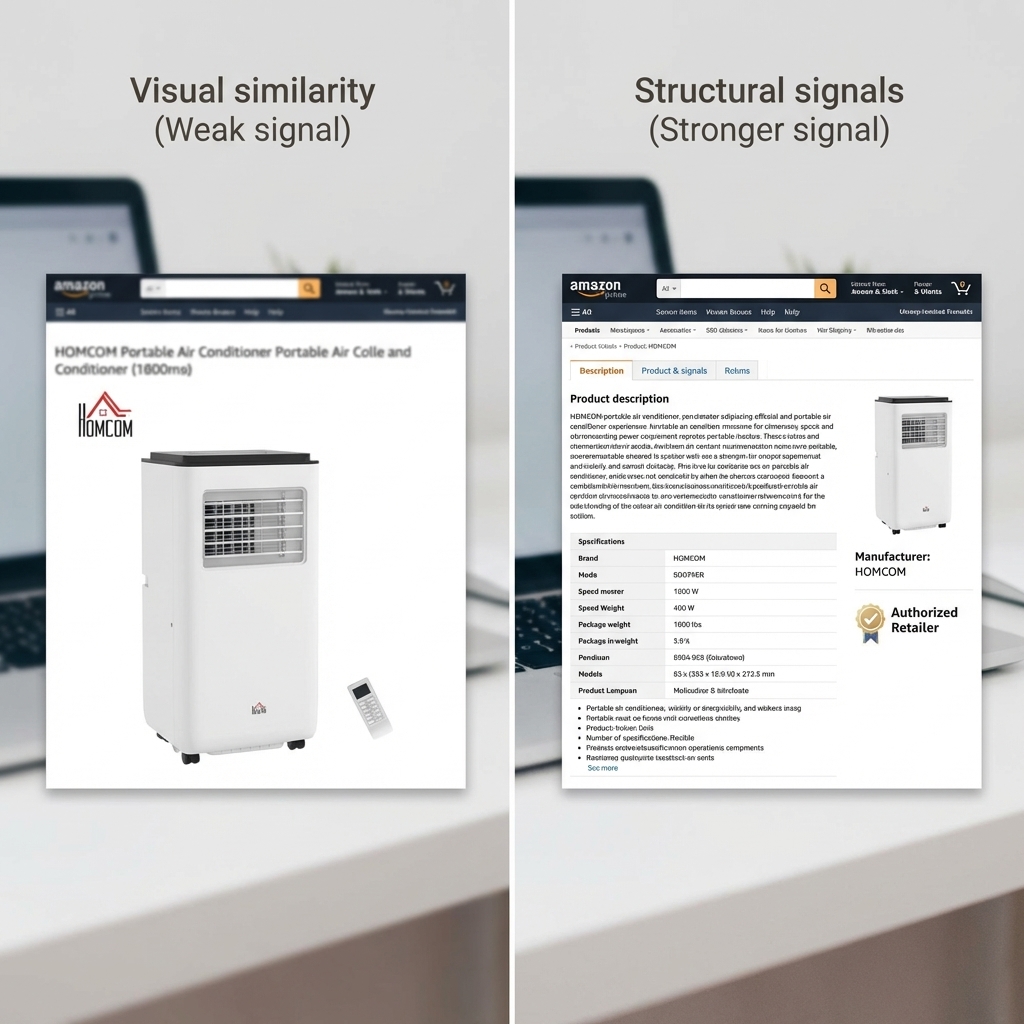
When working out why a HOMCOM air conditioner appears on multiple sites, visual similarity is a weak signal. Structural signals tend to hold up better:
- Seller and fulfilment identity: the legal entity selling the item and who handles delivery and returns.
- Warranty route: whether the site clearly states who provides warranty service and how claims are processed.
- Model identification: the rating plate details and any model code referenced in documentation (often more precise than marketing titles).
- Compliance information: consistent references to safety and environmental requirements expected in the market.
For general product safety expectations and market surveillance principles in the UK context, the Office for Product Safety and Standards provides guidance on how responsibilities sit across manufacturers, importers, and distributors: https://www.gov.uk/government/organisations/office-for-product-safety-and-standards.
Where Confusion Commonly Starts
Two patterns cause most of the uncertainty. First: the same brand name attached to pages that serve different purposes—sales versus support. Second: the assumption that identical photos or identical bullet points prove that two listings are the same. Syndication can make different offers look identical, while small but meaningful differences (seller, warranty handling, included accessories, region-specific compliance) may be easy to miss.
One example of how this can look in the wild is a HOMCOM Portable Air Conditioner listing being mirrored across retailer platforms while its manual is hosted separately; that split is common in distributed retail ecosystems and is not, by itself, suspicious.
Why a HOMCOM Air Conditioner Appears on Multiple Sites
When trying to understand why a HOMCOM air conditioner appears on multiple sites, the most useful lens is distribution, not duplication. A brand name can surface across many domains because modern retail runs on shared catalog data, syndicated listings, and marketplace infrastructure. The same underlying item record (title, images, basic specs) is often reused by different sellers or platforms, each wrapping it in their own page template, customer support area, and local compliance notes.
This pattern is common with large catalogue brands because visibility is created by a network: brand owner, authorised distributors, retail partners, and marketplaces. The result can look like “copies” even when nothing improper is happening. It is also why searches for a HOMCOM Portable Air Conditioner frequently return a mix of storefront pages, help pages, and community troubleshooting threads rather than a single canonical destination.
Catalog Syndication and Page Templates Create Look-Alikes
Many retail sites ingest product information through feeds. These feeds typically include structured fields (name, dimensions, power, features, documentation references) that are mapped into a standard page template. If the same feed powers multiple regions or multiple partners, pages can end up visually and textually similar.
Understanding why a HOMCOM air conditioner appears on multiple sites often comes down to recognising what is “shared” versus what is “site-specific.” Shared elements are the baseline description and imagery. Site-specific elements are pricing, stock status, delivery constraints, warranty handling, and returns workflows. That separation is legitimate, but it can make it harder to tell whether two pages represent the same listing, a regional variant, or a reseller’s re-posting.
Model Names, Variants, and Regional Compliance Notes

A further complication is naming. A “Portable Air Conditioner HOMCOM” listing may use one naming convention on a marketplace and a slightly different one on a retailer site, even when the underlying unit is the same. Some platforms prioritise consumer-facing names; others prioritise internal catalogue labels. On top of that, regional pages may display different energy labels, plug standards, or documentation requirements, which makes the same unit look “different” at a glance.
Where this becomes confusing is when a single base model has small packaging or accessory changes by market. Those changes can be minor yet trigger a separate catalogue entry. That is one reason a HOMCOM air conditioner can appear as multiple near-duplicates without implying counterfeit activity.
- Different page titles may reflect search optimisation rather than a different unit.
- Documentation links can vary by region even when the hardware is unchanged.
- Accessory bundles can create separate listings that still share most of the same text.
Support Content, Manuals, and Community Threads Amplify Visibility
Another reason why a HOMCOM air conditioner appears on multiple sites is that “product presence” is not limited to retail pages. Manuals, troubleshooting posts, retailer Q&A pages, and user forums frequently rank in search results. These pages may repeat the product name, reuse images, or quote portions of documentation. They can also be mirrored by partners that host help content for their own customers.
From a user perspective, this is where uncertainty tends to rise: a documentation page can look official even when it is hosted by a retailer or a content delivery network. The practical implication is that search results are reflecting the information supply chain, not necessarily conflicting sources.
When Multiple Listings Can Signal a Real Mismatch

Most multi-site appearances are routine. Still, there are edge cases where the duplication reflects a mismatch worth noticing. These are usually about traceability and after-sales responsibility rather than performance claims.
- If two pages show materially different electrical ratings or safety marks for what appears to be the same unit, that may indicate a regional variant being presented outside its intended market.
- If warranty language is vague or inconsistent across sellers, the after-sales pathway can become unclear even when the unit itself is genuine.
- If imagery and text are identical but the seller identity is opaque, the listing may be a re-post rather than an authorised distribution channel.
For context on how product safety and market surveillance work in the EU, the European Commission’s overview of product safety and market surveillance is a useful reference: https://commission.europa.eu/strategy-and-policy/policies/justice-and-fundamental-rights/consumer-protection/product-safety_en
Interpreting “Multiple Sites” Without Turning It Into a Buying Problem
It is tempting to treat the multi-site footprint of a HOMCOM portable air conditioner as a signal of quality or legitimacy. In practice, it is usually a signal of distribution breadth and content re-use. The more relevant question is narrower: which page is responsible for fulfilment, documentation, and after-sales handling in a given transaction. That distinction explains most of the confusion behind why a HOMCOM air conditioner appears on multiple sites, without assuming that the pages are competing “versions” of the truth.
How to Sanity-Check Pages Without Turning It Into a Buying Task

The goal is not to “pick the best site”, but to reduce the risk of relying on the wrong page. A few quiet checks usually answer most doubts behind why a HOMCOM air conditioner appears on multiple sites.
Start with signals that are hard to fake at scale: consistent company identity, stable contact details, and a clear separation between brand-owned pages and reseller pages. For documentation, versioning matters more than design. A plain PDF can be more reliable than a polished blog post if it has a publication date and a revision identifier.
- Look for version cues: revision numbers, issue dates, and consistent model naming conventions are more informative than page layout.
- Separate “support” from “sales” content: retailer help pages and community threads can be useful, but they are not the same as controlled documentation.
- Watch for mismatched specifications: when the same description appears but key figures differ, treat it as a sign of partial copying or older revisions.
For general consumer rights context in the UK (often relevant when the same brand appears across several retail channels), guidance from the Competition and Markets Authority can help frame what sellers must provide and how responsibilities are divided: https://www.gov.uk/government/organisations/competition-and-markets-authority
Common Misconceptions That Drive the “Multiple Sites” Question
One misconception is that a brand appearing widely implies a single central “official” page must exist and everything else is suspicious. In retail reality, brand presence is fragmented: different entities may be responsible for listing accuracy, after-sales handling, and documentation hosting.
Another misconception is that duplicated wording equals counterfeit. It can, but duplication is also a by-product of standardised product feeds and retailer templates. The more reliable red flags tend to be inconsistencies that affect traceability: contradictory company details, missing legal information, or documents with no identifiable publisher.
Finally, people often expect search results to prioritise the most current source. Search engines frequently surface pages because of authority and linkage patterns, not because a document is the newest revision. That is why manual PDFs and retailer Q&A threads can outrank more controlled sources.
FAQ: Interpreting Brand Duplication and Source Reliability

Why Does the Same Brand Show Up on Retailer Pages, Forums, and PDF Downloads?
Because product information and documents are often redistributed through supply chains, retailer systems, and mirrored file hosts. The presence itself is not proof of legitimacy; consistency and traceability matter more.
Why Does a HOMCOM Air Conditioner Appear on Multiple Sites Even When the Text Looks Identical?
Identical text commonly comes from syndicated product feeds or reused manufacturer descriptions. Treat identical wording as neutral; focus on whether the page clearly identifies who published it and whether the information is versioned.
How Can a Manual Be “Real” but Still Be the Wrong One?
Documents can be authentic yet outdated, region-specific, or tied to a different revision. Missing publication dates, revision codes, or clear publisher details increases the chance of a mismatch.
Is a Marketplace Listing Automatically Less Trustworthy Than a Brand-Owned Page?
Not automatically. Marketplace pages can be accurate, but they are also more likely to be edited by multiple parties over time, so cross-checking key details against stable documentation is often the safer approach.